
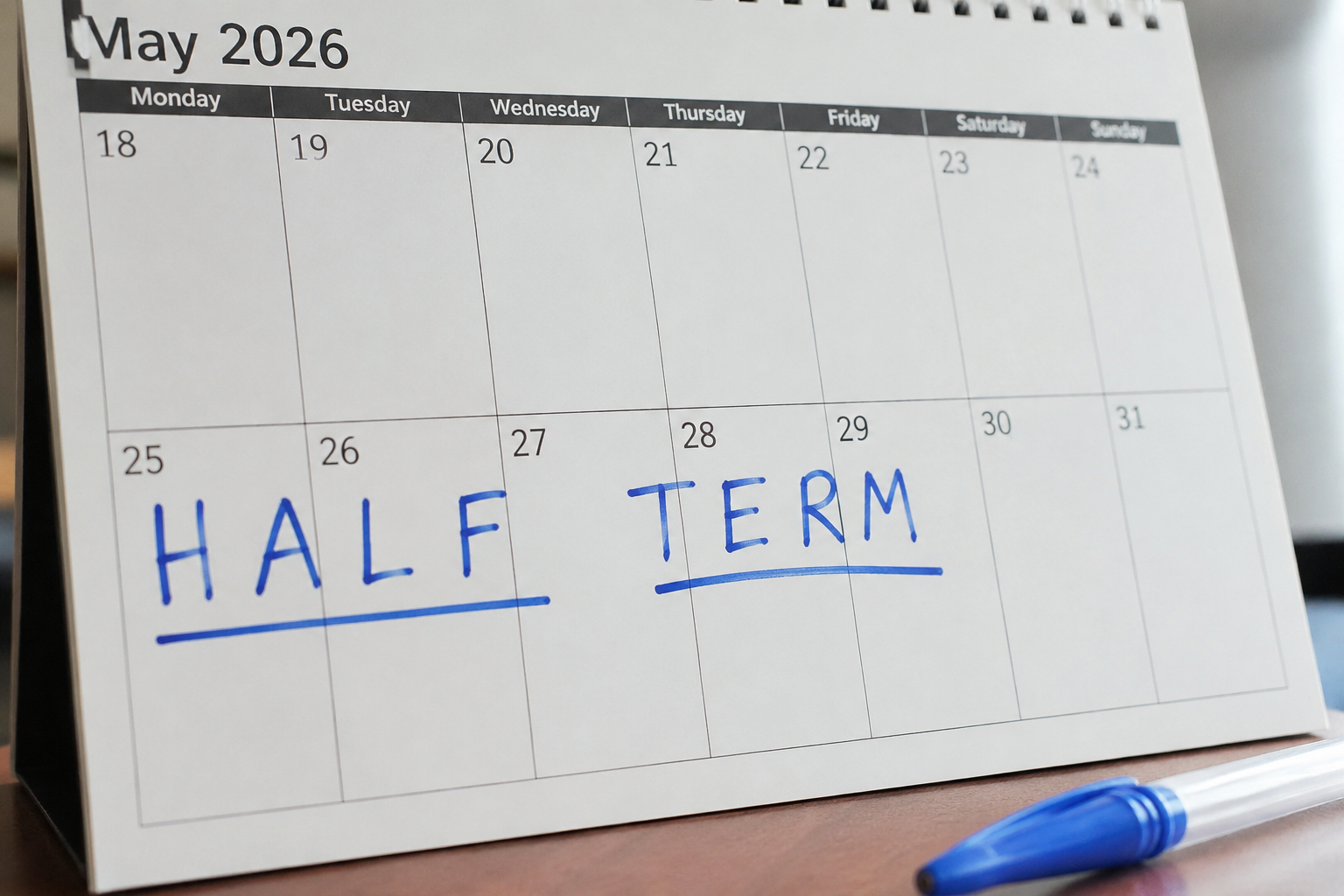
Half Term Isn’t for Cramming. What Students Should Actually Do Before the Final Weeks of GCSEs
By Julian Dance, Head of Big Ideas at SideCog.
For many students, this half term feels strange.
Some exams are already finished. Others still hang over them. The adrenaline of the first GCSE papers has worn off, but there are still crucial weeks ahead - including four remaining science papers for many students.
This is often the point where revision becomes chaotic.
Students start:
rereading notes for hours,
highlighting entire textbooks,
watching endless revision videos,
panicking about everything they “don’t know”.
But cognitive science research suggests something important:
More revision does not automatically mean more learning.
In fact, some of the most common revision habits create the illusion of understanding without actually strengthening memory or improving exam performance.
So instead of turning half term into a marathon of cramming, students should focus on something far more effective: Understanding
Why Cramming Stops Working
By this stage of GCSEs, most students have already seen the content many times.
The problem usually is not:
“I’ve never learned this.”
It is:
“I can’t reliably retrieve it, apply it, or explain it under pressure.”
Research from cognitive scientists such as Professor Robert Bjork and educational psychologists including Professor Daniel Willingham has repeatedly shown that familiarity is not the same as mastery.
A topic can feel familiar because:
you recognise the page,
you remember the teacher explaining it,
you’ve watched a video on it before.
But recognition is very different from being able to:
answer an unfamiliar exam question,
connect ideas together,
explain reasoning,
avoid misconceptions under pressure.
This is why students often say:
“I knew it when I revised.”
but cannot reproduce it in the exam hall.
The Goal for Half Term
The goal is not: “How many hours can I revise?”
The goal is: “How can I strengthen understanding and retrieval before the final papers?”
That requires a completely different approach.
1. Draw What You Know - Don’t Just Read It
One of the most powerful revision techniques is also one of the simplest: draw the concept. The drawing effect in learning improves memory and understanding.
.jpeg)
This is known in cognitive science as: dual coding. Dual coding combines:
verbal information,
with visual representation.
The reason it works is because the brain stores information more effectively when ideas are represented in multiple ways.
Importantly, students do not need to be artistic.
Simple diagrams, arrows, flow charts, stick figures and labelled sketches are often far more effective than pages of notes.
For GCSE science in particular, drawing is incredibly powerful because so much of the subject relies on:
processes,
systems,
relationships,
movement,
cause and effect.
Instead of rereading notes on:
osmosis,
the heart,
electrolysis,
energy transfer,
inheritance,
the carbon cycle,
students should try:
drawing the process from memory,
sketching labelled diagrams,
creating flow maps,
linking ideas with arrows,
explaining diagrams aloud.
This matters because drawing forces students to:
organise knowledge,
simplify ideas,
identify missing understanding,
connect concepts together.
And that is real learning.
Why Drawing Works Better Than Highlighting
Highlighting often creates familiarity.
Drawing exposes understanding.
.jpeg)
A student may recognise a textbook page on electrolysis - but struggle to draw:
- the movement of positive and negative ions,
- why opposite charges attract,
- where oxidation and reduction happen,
- what is produced at the anode and cathode,
- how electrons move through the external circuit,
- why the substance must be molten,
- how charge is balanced throughout the process.
That gap matters.
A student who can recreate and explain a diagram like this from memory is not simply recalling isolated facts - they are showing that they understand the relationships, processes and underlying concepts involved.
And that is exactly why drawing is such a powerful revision strategy.
2. Revise in Short Bursts of Deep Thinking
One of the biggest revision myths is that effective students sit for hours without stopping.
In reality, the brain struggles to sustain intense concentration for long periods - especially when the task involves genuine thinking.
And genuine learning should feel mentally effortful.
This is why many cognitive science approaches favour short periods of highly focused work followed by deliberate breaks.
For many students, this looks like:
20–30 minutes of intense, uninterrupted thinking,
followed by a short reset,
before switching topic or task.
During those focused blocks, students should avoid passive revision and instead do work that forces the brain to actively process information.
For example:
drawing a process from memory,
answering exam questions cold,
explaining a concept aloud,
building a knowledge map,
recreating diagrams without notes,
identifying misconceptions.
This type of thinking is tiring because it strengthens learning.
The break matters too.
Stepping away briefly:
reduces cognitive overload,
helps attention recover,
improves focus in the next session,
supports memory consolidation.
Importantly, students should not interpret mental fatigue as failure.
Often, the feeling of:
“this is hard”
is actually a sign that real learning is taking place.
Five deeply focused 20-minute sessions are often far more effective than five hours of distracted revision.
3. Focus on Retrieval, Not Rereading
One of the strongest findings in cognitive science is the power of retrieval practice.
This means trying to remember information without looking at the answer first.
- Not reading.
- Not highlighting.
- Not copying notes.
- Actually retrieving.
Examples include:
blurting everything you know about a topic from memory,
answering exam questions cold,
drawing processes from memory,
explaining concepts aloud,
covering diagrams and recreating them,
self-quizzing before checking notes.
This feels harder than rereading because it is harder.
But that difficulty is precisely what strengthens memory.
Professor Bjork describes this as a “desirable difficulty” - effort that improves long-term retention.
4. Use Exam Questions to Diagnose Understanding
Past papers are useful - but not in the way many students use them.
Doing endless papers without reflection often becomes repetition, not learning.
Instead, students should treat exam questions as diagnostic tools.
After every mistake, ask:
Did I misunderstand the concept?
Did I misread the question?
Did I forget key knowledge?
Was there a misconception underneath?
Could I draw or explain why the correct answer is right?
This is especially important in science subjects, where many errors come from flawed mental models rather than missing facts.
For example:
confusing current with voltage,
misunderstanding particle movement,
mixing up osmosis and diffusion,
learning equations without understanding relationships.
Very often, students realise they cannot actually visualise the process properly.
Drawing the concept can immediately expose this.
5. Build Connected Knowledge
Strong learning is not isolated.
Knowledge works best when ideas connect together.
This matters hugely in GCSE science because topics overlap constantly:
energy links to electricity,
cell biology links to transport,
bonding links to structure and properties,
forces connect to motion and energy transfer.
Students who only memorise isolated facts often struggle when questions become unfamiliar.
Students who understand the big ideas underneath can adapt much more effectively.
One powerful strategy is creating connected knowledge maps.
For example:
linking respiration to exercise,
linking photosynthesis to ecosystems,
linking electricity to energy transfer,
linking particle theory to states of matter.
When students physically map connections between ideas, they strengthen understanding far more effectively than rereading isolated pages.
6. Explain Thing Simply
A powerful way to test understanding is simple: Can you explain it clearly without notes?
Educational research consistently shows that explaining concepts helps reveal hidden gaps in knowledge.
If a student cannot explain:
photosynthesis,
electrolysis,
inheritance,
rates of reaction,
energy transfer,
in simple language, there is usually still a weakness in understanding.
Try:
teaching a parent,
explaining to a friend,
talking through diagrams,
recording voice notes,
drawing while explaining.
The goal is not sounding clever.
The goal is making ideas make sense.
7. Don’t Fill Every Hour
This surprises many parents and students.
But effective revision is not about exhausting the brain.
Memory consolidation requires:
breaks,
sleep,
recovery,
spacing.
The Education Endowment Foundation and wider cognitive science research both support spaced learning over mass cramming.
Students who work intensely for 10 hours often retain less than students who:
revise in focused blocks,
revisit material repeatedly over days,
sleep properly,
take recovery time.
Half term should include rest.
Not because rest is avoiding work - but because rest helps learning stick.
8. Prioritise Confidence Through Competence
Many students try to “feel confident” before exams.
But confidence built on reassurance disappears quickly.
Real confidence usually comes from:
successful retrieval,
genuine understanding,
repeated application,
recognising improvement.
That is why the most effective revision often feels less dramatic.
It is quieter.
More structured.
More reflective.
And usually far more effective than panic-driven cramming.
A Better Question for the Final 3 Weeks
Instead of asking: “How much revision have I done?”
students should ask: “What do I understand more deeply today than I did last week?”
Because GCSE success is not just about seeing information repeatedly.
It is about building knowledge that can still be used:
under pressure,
in unfamiliar questions,
across different contexts,
long after the exam is over.
And that kind of learning is built through understanding - not just memorisation.
Further Reading
Written by
Julian Dance
Related articles
- SideCog Shorts | I want to help my child with revision, but I don’t know how.
Help your child revise without needing to know every answer. Join Julian for four practical 15-minute sessions on getting started, asking useful questions, trying better techniques and noticing progress.
28 September 2026
- Why Go and Revise So Often Ends in an Argument
What two decades in classrooms have taught me about why teenagers struggle to start revising and how parents can help
24 September 2026
- What Trying to Speak Italian Taught Me About Learning
A 658-day Duolingo streak doesn't necessarily make you confident enough to order dinner. A family holiday in Sardinia got Julian thinking about context, confidence, retrieval - and the difference between completing activities and actually learning.
27 August 2026
- Flashcards - Are You Revising or Just Copying?
Flashcards are one of the most popular revision tools, but using them badly can create the illusion of learning. Julian explores how to make them work harder.
10 August 2026