How Many Marks for Asparagus? Why Understanding Beats Memorisation
By Julian Dance —
Tags: Understanding vs Recall, Long-term Memory, Misconceptions, Schema Building, Deeper Understanding, Learning & Memory
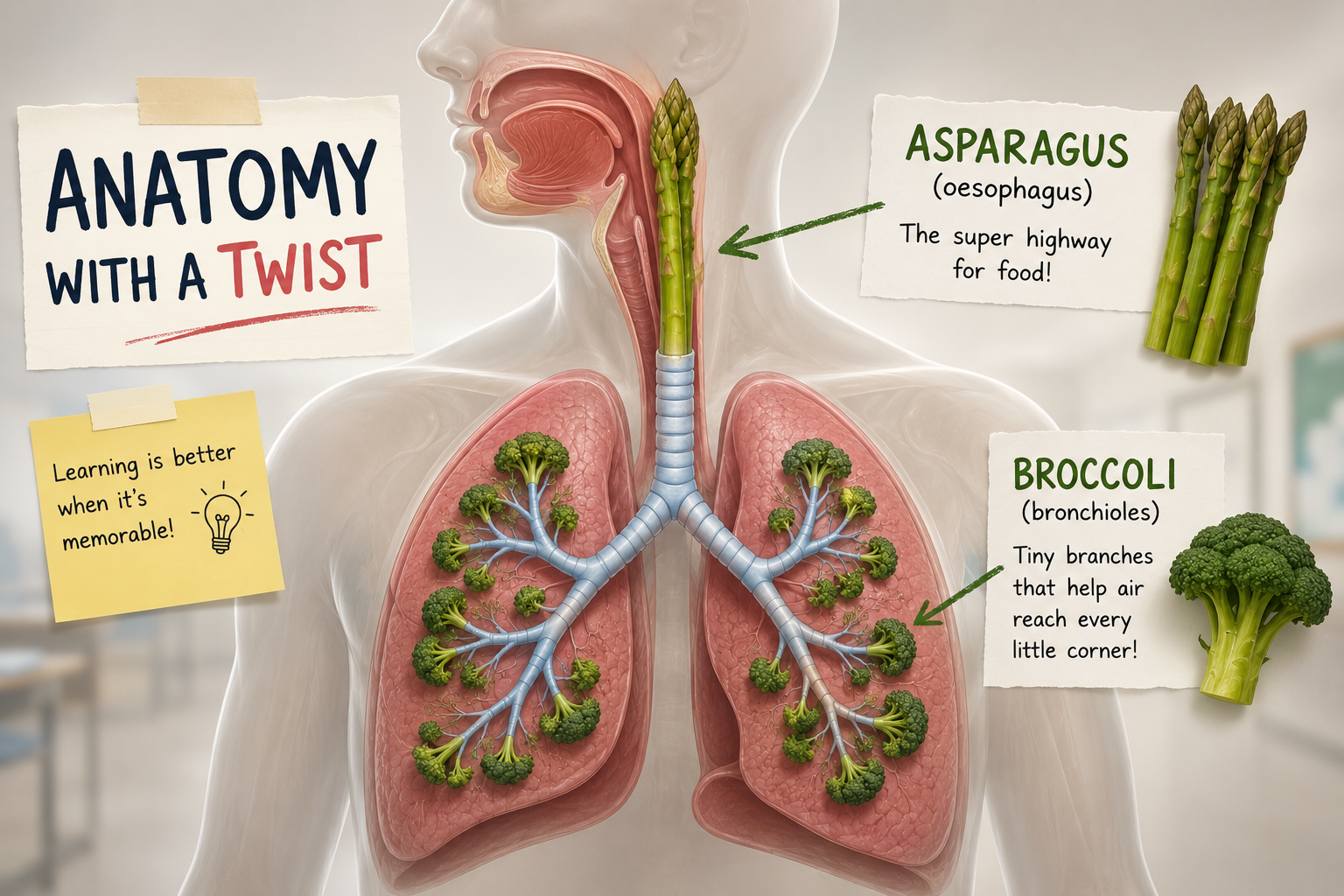
A student labelled the oesophagus as "asparagus" and the bronchioles as "broccoli". Funny? Absolutely. But the story reveals something important about the difference between recall and genuine understanding.
By Julian Dance, Co-Founder of SideCog, Head of Science and Head of Big Ideas How Many Marks for Asparagus? I was standing in a school corridor recently, probably on toilet duty, holding a pile of handouts showing a diagram of the human lungs. I was on my way to teach a lesson where students would be expected to label the diagram. A fairly standard science task. Name the parts. Get the spellings right. Collect the marks. As I waited, a curious student wandered over. "What's that?" I showed him the sheet. "It's a diagram of the lungs. The class will be labelling it in a minute." The student looked at it briefly. "I can do that." Confidently, he pointed to one structure. "That's the asparagus." The oesophagus. Then another. "And those are the broccolis." The bronchioles. At this point, most teachers would probably be trying very hard not to laugh. The obvious answer is zero marks. But perhaps the more interesting question is: What does this student actually understand? Because despite getting the labels completely wrong, he has recognised that the diagram contains named structures. He understands that those structures have labels attached to them. He understands that the task involves matching names to parts. What he doesn't yet understand is what those structures are, what they do, or how they connect together. And that's where things get interesting. The Difference Between Naming and Understanding In schools, we often reward students for correct answers. Sometimes that's appropriate. But correct answers and understanding are not the same thing. A student can memorise "oesophagus" perfectly and still have no real idea what it does. They can learn "bronchioles" for tomorrow's test and forget them a week later. They can label a diagram accurately while holding major misconceptions about how breathing actually works. The reverse can also be true. A student might not remember the precise terminology but may have a surprisingly strong mental model of the system itself. Educational research consistently shows that deep understanding comes not from isolated facts but from connected knowledge. Students need to know: What each structure does. How it relates to other structures. Why it matters. What misconceptions commonly occur. How the entire system works together. Without those connections, learning often becomes little more than vocabulary practice. The Problem with Surface Learning Many students become very good at recognising terms. Far fewer develop robust understanding. That's partly because traditional learning often focuses on what is easiest to assess: Can you name it? Can you define it? Can you recall it? These are important foundations. But they are only the beginning. Real understanding emerges when students can explain, reason, apply, predict and connect ideas together. For example: Instead of simply identifying the bronchioles, could a student explain how air travels through the respiratory system? Could they predict what would happen if one part stopped functioning properly? Could they connect the lungs to circulation, exercise, gas exchange and energy production? Those are the kinds of questions that reveal understanding. Why Misconceptions Matter The asparagus-and-broccoli story is funny because it highlights an obvious mistake. But every student carries misconceptions that are much harder to spot. Some think heavier objects fall faster than lighter ones. Some think seasons are caused by Earth being closer to the Sun. Some believe breathing means taking oxygen in and carbon dioxide out, without understanding gas exchange at all. The challenge for educators is not simply delivering information. It is uncovering what students currently believe and helping them rebuild accurate mental models. That process requires diagnosis, feedback and carefully structured teaching. What We Believe at SideCog At SideCog, we believe learning should go beyond remembering labels. Knowing that a structure is called the oesophagus is useful. Understanding how body systems connect together is transformative. That's why our approach focuses on: Diagnosing misconceptions. Teaching for understanding. Building connected knowledge. Strengthening long-term retention. Developing learner confidence. Because in the real world, success rarely comes from remembering isolated facts. It comes from understanding how ideas fit together. Although, if we're being generous, perhaps "asparagus" deserves half a mark for effort. The broccoli, however, might be harder to justify.