
Making Every Lesson Count - 6 Principles That Improve Science Teaching

By Julian Dance - Head of Big Ideas at SideCog
There are very few books in education that genuinely change how you think about teaching. Making Every Lesson Count by Shaun Allison and Andy Tharby is one of them.
It is not a book of strategies in the usual sense. There are no gimmicks, no quick wins, no performative techniques. What it offers instead is clarity - and in education, clarity is rare.
I have returned to it repeatedly over the years because it reflects what actually works in classrooms. Not in theory, but in practice - particularly in complex subjects like science, where misunderstanding compounds quickly if it is not addressed early.
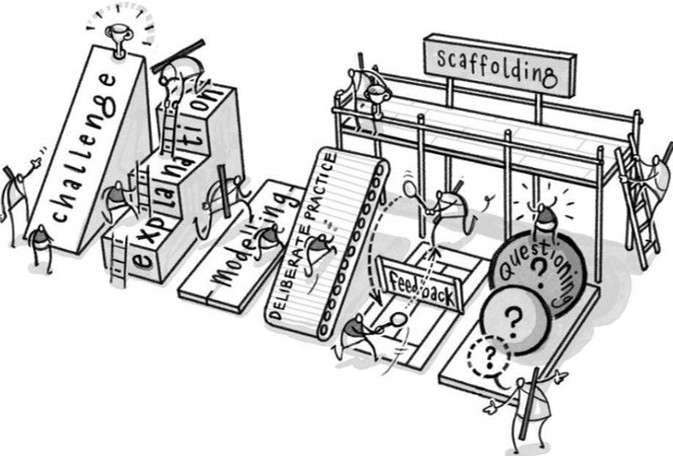
Reproduced from Making Every Lesson Count by Shaun Allison and Andy Tharby (Crown House Publishing, 2015).
1. Challenge: Where learning actually begins
One of the most important shifts this framework encourages is a reframing of challenge. Too often, challenge is mistaken for surface-level difficulty - harder questions, more content, faster pace. But in science, real challenge is cognitive.
It is the difference between asking a pupil what happens and asking them to explain why it happens, how it connects to prior knowledge, or what would change under different conditions. That is where learning sits.
This becomes even more important when we consider how knowledge builds over time. As explored in Why Connected Knowledge Matters More Than Ever in Education, isolated understanding is fragile. Challenge only has impact when it is rooted in a connected curriculum.
2. Explanation: The quiet driver of understanding
Explanation is one of the most underestimated aspects of teaching. In science, clarity is everything.
Poor explanations do not just slow learning - they create misconceptions that can persist for years. A vague explanation of energy or particle behaviour can fundamentally distort how a pupil understands the subject.
Clear explanation reduces cognitive load and helps pupils build accurate mental models. It also connects directly to what we know about knowledge and thinking: Why Knowing More Changes How Students Think and Learn makes this explicit - knowledge is not just something pupils acquire, it shapes how they reason.
3. Modelling: Showing pupils how to think
We often assume that once something has been explained, pupils can apply it. In reality, they need to see what success looks like.
Modelling makes thinking visible. It shows how to approach a problem, how to structure an answer, and how to use scientific vocabulary with precision. It also shows pupils how to deal with mistakes - something that is rarely made explicit but critically important.
This is particularly powerful for pupils who lack confidence. By removing ambiguity, modelling creates a clear entry point into the task and reduces the likelihood of disengagement.
4. Practice: Building knowledge that lasts
Practice is not about repetition - it is about reinforcement through variation and connection.
In science, effective practice revisits core ideas across different contexts. Concepts such as energy, forces, and particle behaviour should not sit in isolated units; they should reappear and deepen over time.
This is why curriculum design matters. As explored in Why Connected Knowledge and Big Ideas Transform GCSE Science Learning, when knowledge is structured around big ideas, practice becomes far more powerful because it strengthens connections rather than reinforcing fragmentation.
5. Feedback: Only useful if it changes something
Feedback should move learning forward. It should be specific, actionable, and focused on what the pupil should do next.
But feedback only works if it is used. Pupils must be given time to reflect, respond, and improve. Without that, feedback becomes performative rather than impactful.
This links closely to attention and engagement. If pupils are not cognitively present, feedback has limited impact - a theme explored in Are You Paying Attention?, where attention is positioned as a prerequisite for learning.
6. Questioning: The lever for deeper thinking
If there is one principle that consistently transforms classrooms, it is questioning.
Questioning reveals thinking. It exposes misconceptions. It builds connections. In science, where understanding is layered and cumulative, this is essential.
It also helps address a common misconception about practical work. As discussed in Why Practical Work Alone Doesn’t Teach Science, simply doing experiments is not enough. It is the questioning around those experiences - the probing, the explanation, the linking - that drives learning.
Over time, improving questioning often comes down to a simple shift: saying less, and asking more.
What This Looks Like in Science Learning
The principles in Making Every Lesson Count are especially powerful in science, where it’s easy for students to appear confident without fully understanding.
Here’s what that looks like in practice:
Cells: More Than a Diagram
A student might be able to draw and label a perfect cell. But real understanding goes further:
Can they explain what the nucleus actually does?
Can they describe how the cell membrane controls what enters and leaves?
Can they apply this knowledge to explain how different cells (e.g. muscle vs nerve) are specialised?
This is the difference between remembering and understanding.
Chemical Reactions: Not Just Following Steps
In a practical, a student might correctly carry out an experiment - for example, heating a substance or mixing chemicals. But deeper learning means:
Explaining what is happening at a particle level
Understanding why a reaction occurs
Predicting what would happen if conditions changed
Science isn’t just doing - it’s explaining.
Electricity: Beyond the Formula
A student might successfully calculate current using a formula. But do they:
Understand what current actually is (flow of charge)?
Explain why increasing voltage changes current?
Apply their knowledge to real circuits?
Knowing the formula is only the starting point.
Energy: Connecting Ideas
A student may recall that “energy cannot be created or destroyed.” But deeper understanding involves:
Explaining energy transfers in real systems
Identifying where energy is “lost” (e.g. as heat)
Applying the concept to everyday examples (cars, appliances, the human body)
The Pattern in Science Learning
Across all topics, the same pattern appears:
Surface learning = copying diagrams, memorising facts, following steps
Deep learning = explaining processes, connecting ideas, applying knowledge
Why This Matters
In science, misconceptions are common - and often hidden.
Students can:
Produce correct answers
Complete practicals
Memorise definitions
…but still lack the underlying understanding needed to succeed in exams or real-world thinking.
The Role of Structure
This is why structured approaches - like those outlined in Making Every Lesson Count - matter so much.
By combining:
Clear explanations
Modelling
Deliberate practice
Targeted questioning
Scaffolded support
…students move from surface performance to genuine understanding.
Why these 6 principles are still relevant
What makes Making Every Lesson Count so powerful is not that the principles are new. It is that they are coherent and practical. They reflect the reality of classrooms.
When combined with a curriculum built around big ideas and connected knowledge, these principles become transformative. Pupils move beyond memorising facts and begin to understand how science works.
That shift - from surface learning to deep understanding - is what ultimately changes outcomes. Not just in exams, but in how pupils think.
After fifteen years in the classroom, I am more convinced than ever that great teaching is not about doing more. It is about doing the right things, deliberately and consistently.
This framework helps us do exactly that.
Further Reading
Written by
Julian Dance
Related articles
- SideCog Shorts | I want to help my child with revision, but I don’t know how.
Help your child revise without needing to know every answer. Join Julian for four practical 15-minute sessions on getting started, asking useful questions, trying better techniques and noticing progress.
28 September 2026
- AI Can Answer a Question, But Can It Teach?
AI can answer questions, but can it teach? Discover why SideCog puts pedagogy, adaptive teaching and lasting learning at the heart of educational AI.
22 September 2026
- Can Attendance and Behaviour Really Be Linked in an Ofsted Report?
When a school has excellent behaviour but still receives a “Needs Attention” judgement because of attendance, it raises an important question: how much can schools really control? After 20 years in education, Julian Dance reflects on attendance, curriculum relevance and whether we need to look more closely at why some young people disengage from learning.
8 September 2026
- What Trying to Speak Italian Taught Me About Learning
A 658-day Duolingo streak doesn't necessarily make you confident enough to order dinner. A family holiday in Sardinia got Julian thinking about context, confidence, retrieval - and the difference between completing activities and actually learning.
27 August 2026