
Metacognition: The Learning Habit That Helps Your Child Make Real Progress
By Gareth Moores, Educational Lead at SideCog.
Metacognition: the habit behind real learning
Metacognition is a simple idea with powerful consequences. It means noticing how you learn - making a plan, checking what is working, and changing your approach when it isn’t.
In practice, it turns effort into progress.
Many students spend hours revising but see limited improvement. The issue is rarely effort; it is strategy. Without metacognition, learning can become passive - rereading notes, highlighting, or completing tasks without really thinking about whether understanding is improving.
With metacognition, learning becomes active. Students set goals, check their understanding, and adjust when needed. Over time, this builds confidence, independence, and resilience.
Your child’s ‘internal coach’
A helpful way to think about metacognition is as an internal coach guiding your child through their learning.
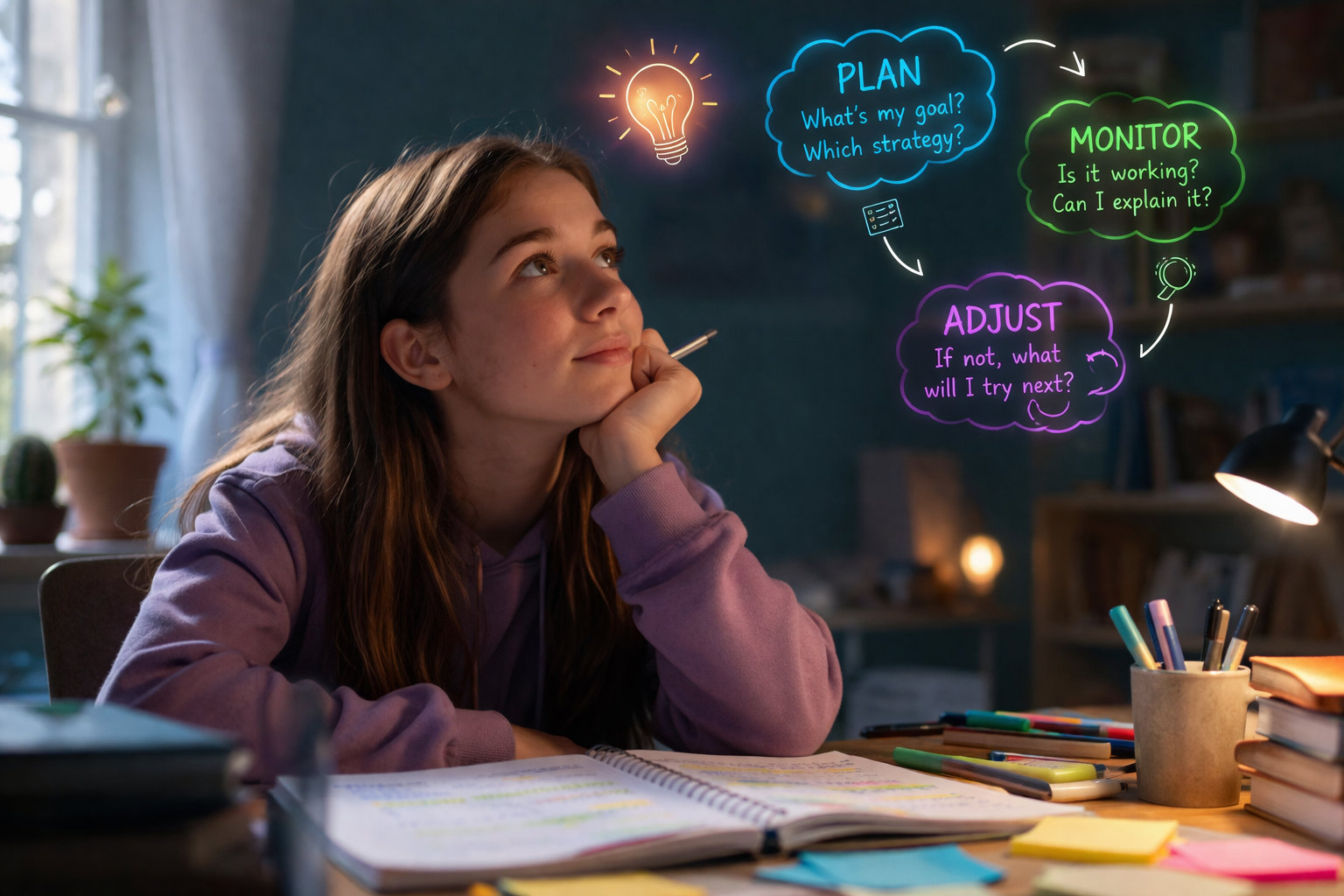
It works in three simple stages:
Plan: What am I trying to achieve? What strategy will I use?
Monitor: Is this working? Can I explain it clearly?
Adjust: If not, what will I try next?
This might sound structured, but in reality it becomes a quiet habit - small decisions made during learning that lead to much better outcomes.
Take a science example. A student learning about energy transfers might begin by reading key ideas and attempting a few questions. As they work, they realise they understand conduction but are unsure about convection. Instead of pushing on blindly, they pause, sketch a diagram, explain it out loud, and try again.
That moment - noticing confusion and doing something about it - is metacognition in action.
Why this matters for GCSE success
Metacognition is not tied to one subject. It improves learning everywhere.
Students who develop this habit tend to:
Learn more efficiently, focusing on what actually improves understanding
Handle difficult or unfamiliar topics with greater confidence
Persist when work becomes challenging because they have alternative strategies
Work more independently, both in and out of school
This is particularly important at GCSE, where students must manage their own revision and apply knowledge across different contexts.
Metacognition and organisation: working together
Metacognition is often discussed alongside executive functioning, and the distinction matters.
If metacognition is the coach, executive functioning is the manager - organising time, starting tasks, maintaining focus, and keeping track of steps.
For example:
Planning a science practical relies on organisation
Choosing the best way to understand the concept relies on metacognition
Starting an essay requires organisation
Improving it midway requires metacognition
Together, they form the foundation of independent learning.
What strong teaching looks like
In effective classrooms, metacognition is not left to chance. Teachers build it deliberately into lessons.
You might see teachers:
Thinking aloud while solving problems, making their decision-making visible
Teaching strategies explicitly (plan → monitor → evaluate)
Asking questions like “Is this working?” or “How do you know?”
Building in short reflection points to review learning
Over time, these routines shift responsibility from teacher to student - helping learners take control of their own progress.
Simple ways to support at home
You do not need subject expertise to support metacognition. Small changes in how you talk about learning can make a significant difference.
Start with simple questions:
“What’s your plan for this?”
“How will you know you’ve understood it?”
“What will you try if that doesn’t work?”
When your child is stuck, avoid jumping straight to answers. Instead, prompt them to think:
“What else could you try?”
“Have you seen something like this before?”
Breaking tasks into manageable steps can also help. A simple “First… then… finally…” approach turns something overwhelming into something doable.
Just as important is reflection. A short, calm conversation after studying - what worked, what to change - builds independence far more effectively than checking whether work is finished. Why 'go and revise' ends in an argument.
Two habits that make the biggest difference
Alongside metacognition, two evidence-informed strategies consistently improve learning:
Retrieval practice
Encourage your child to recall information from memory. This could be quick questions, a short quiz, or summarising ideas without notes. It strengthens understanding and reveals gaps. Flash cards - revising or copying?
Spacing
Revisit ideas over time rather than in one long session. Short, repeated practice leads to better long-term retention.
Combined, these approaches turn revision into something far more effective.
A simple 25 – 30 minute routine might include:
A short memory check
Focused practice on a difficult area
A quick reflection on what worked and what to adjust
How SideCog supports this
SideCog is designed to build these habits naturally as students learn.
It prompts planning before tasks, encourages students to monitor their understanding, and nudges them towards better strategies when they are stuck. Short self-checks and reflections help make learning visible, while structured tasks support focus and organisation.
Over time, these small moments build something powerful: learners who know what to do next.
A small change that makes a big difference
If you try just one thing this week, make it this:
At the start of study: “What’s your plan?”
At the end: “What worked best? What will you change next time?”
It takes less than a minute, but it shifts learning from passive to purposeful.
Final thought
Metacognition is not a buzzword. It is the everyday habit of thinking about how you learn.
When students develop it, they become more confident, more independent, and more effective - not just in exams, but in any new challenge they face.
And that is what real progress looks like.
Further reading
Education Endowment Foundation (EEF): Metacognition and Self-Regulated Learning (Guidance summary). Clear, practical overview of what metacognition is and how schools build it. https://educationendowmentfoundation.org.uk/education-evidence/guidance-reports/metacognition
EEF Teaching & Learning Toolkit: Metacognition and self-regulation. Short explainer on impact and ideas used by schools.
https://educationendowmentfoundation.org.uk/education-evidence/teaching-learning-toolkit/metacognition-and-self-regulationThe Learning Scientists: Retrieval Practice & Spaced Practice. Accessible tips and downloadable posters for building effective learning habits.
Nature Reviews Psychology: “The science of effective learning with spacing and retrieval practice” (2022). A readable overview of why spacing and self-testing help learners of all ages. https://www.nature.com/articles/s44159-022-00089-1
Association for Psychological Science (APS): “Test-enhanced learning”Short, non-technical article on why self-testing boosts long-term learning. https://www.psychologicalscience.org/observer/test-enhanced-learning-2
Written by
Gareth Moores
Related articles
- SideCog Shorts | I want to help my child with revision, but I don’t know how.
Help your child revise without needing to know every answer. Join Julian for four practical 15-minute sessions on getting started, asking useful questions, trying better techniques and noticing progress.
28 September 2026
- Why Go and Revise So Often Ends in an Argument
What two decades in classrooms have taught me about why teenagers struggle to start revising and how parents can help
24 September 2026
- What Trying to Speak Italian Taught Me About Learning
A 658-day Duolingo streak doesn't necessarily make you confident enough to order dinner. A family holiday in Sardinia got Julian thinking about context, confidence, retrieval - and the difference between completing activities and actually learning.
27 August 2026
- Flashcards - Are You Revising or Just Copying?
Flashcards are one of the most popular revision tools, but using them badly can create the illusion of learning. Julian explores how to make them work harder.
10 August 2026