
The Flexible Brain - The Learning Science Students Aren’t Taught - But Should Be
By Gareth Moores, Educational Lead at SideCog.
If you’ve ever heard a teenager say, “I’m just not a science person,” you’re in very familiar territory.
For years, many of us have believed comforting ideas like:
“I learn best visually.”
“Some people are just naturally academic.”
“I’m more right-brained than logical.”
They sound reassuring.
But modern neuroscience tells a different - and much more hopeful - story.
Your brain is far more flexible and capable of change than most people realise. And when you combine that understanding with the right study strategies, plus tools like SideCog, learning becomes more effective, more manageable, and much more confidence-building.
What Does Neuroscience Actually Say About Learning?
Here’s the key truth: The brain changes physically when we learn.
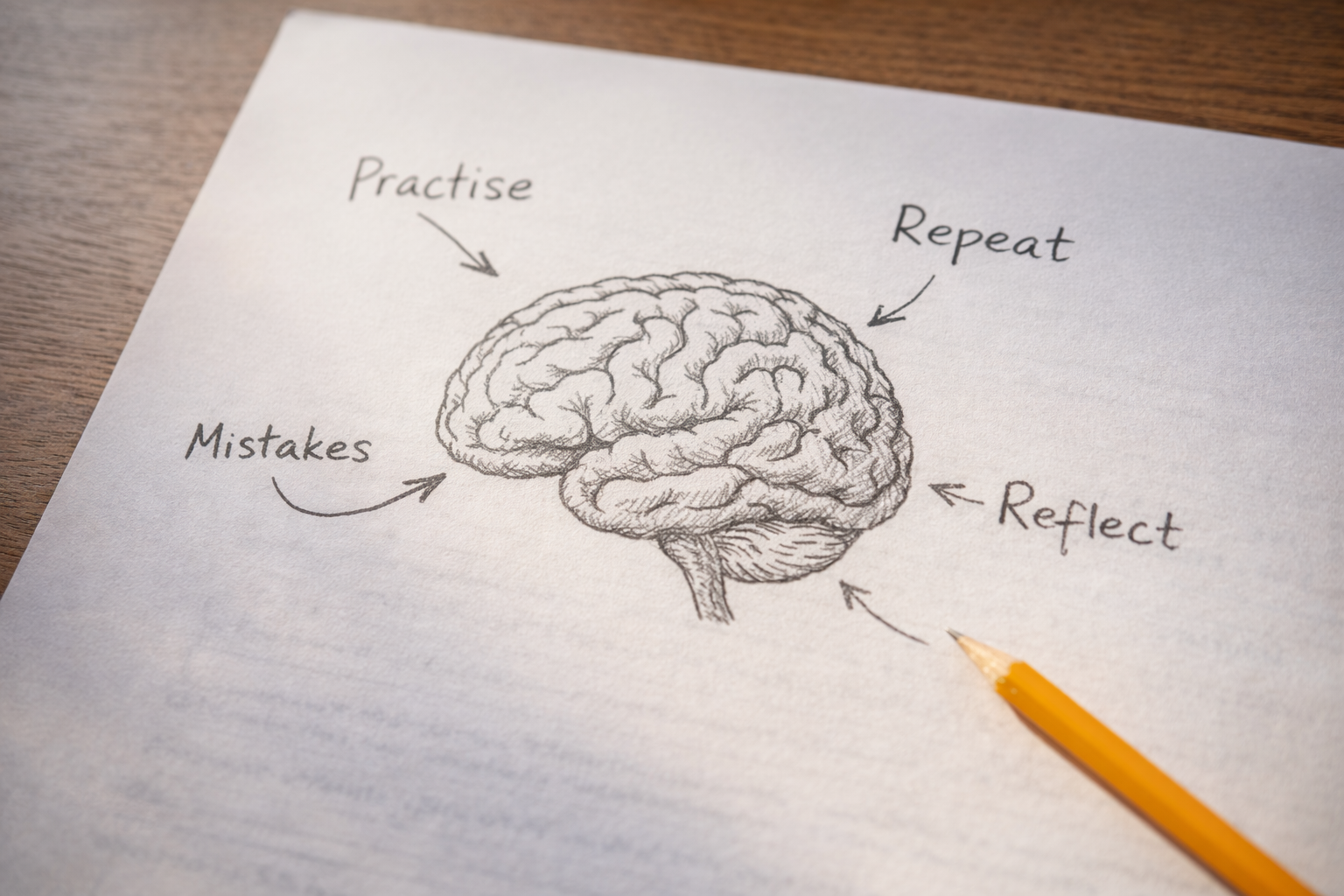
This ability is called neuroplasticity - the brain’s capacity to reorganise itself by forming and strengthening neural connections.
It doesn’t stop in childhood.
It continues throughout life.
When students:
Practise retrieving information
Correct mistakes
Try different approaches
Reflect on what worked
They are not just “covering content.”
They are physically strengthening the neural pathways that support learning.
Learning literally reshapes the brain.
The Brain Myths We Still Hear - But Don’t Need
Modern research has challenged several popular ideas about learning.
Myth 1: “Multiple Intelligences” Means Fixed Strengths
Howard Gardner’s theory proposed different kinds of intelligence (musical, logical, interpersonal and so on). It’s an appealing framework.
But research suggests the brain does not operate as separate “intelligence zones.” Cognitive processes are highly interconnected, and intelligence is more integrated than neatly compartmentalised.
The risk? Students start to label themselves.
“I’m not logical.”
“I’m not academic.”
That belief can become limiting.
Myth 2: Learning Styles Improve Results
The idea of “visual learners” and “kinaesthetic learners” feels intuitive.
However, research consistently shows that matching teaching to a supposed learning style does not improve learning outcomes.
In fact, labels can narrow students’ expectations of themselves.
Effective learning strategies work across subjects and across learners.
Myth 3: “We Only Use 10% of Our Brain”
This is simply untrue.
Brain imaging shows that multiple regions are active even during basic tasks and rest. The brain is constantly working.
Myth 4: Right-Brained vs. Left-Brained People
Creativity and logic are not housed on separate sides of the brain.
Most complex tasks require cooperation between both hemispheres.
What Is True: The Brain Learns by Changing
Neuroplasticity is not a motivational slogan. It is biological reality.

Two brain regions are especially important in learning:
The Prefrontal Cortex
Located just behind the forehead, this region supports:
Focus
Planning
Decision-making
Monitoring thinking
It plays a key role in metacognition - thinking about your thinking - and is highly adaptable through practice.
The Hippocampus
Deep inside the brain, the hippocampus is central to forming and organising new memories. It physically changes as learning occurs.
These regions work together:
The prefrontal cortex guides strategy.
The hippocampus strengthens memory.
Metacognition directs the learning.
Neuroplasticity builds it.
What Is Metacognition - and Why Does It Matter?
Metacognition simply means:
Thinking about how you are learning. It involves:
Planning how to approach a task
Monitoring whether it’s working
Adjusting strategy when needed
Metacognition doesn’t make learning harder.
It makes it smarter.
It helps students move away from comfortable but ineffective habits (like rereading notes) and toward strategies that genuinely strengthen memory.
Four GCSE-Friendly Strategies That Build the Brain
These strategies are supported by cognitive science and align with how the brain changes through learning:
1. Retrieval Practice
Quiz yourself. Don’t just reread.
2. Spaced Practice
Revisit content over days and weeks instead of cramming.
3. Interleaving
Mix topics rather than studying one block repeatedly.
4. Using Mistakes
Correcting errors strengthens memory more than getting everything right first time.
These approaches trigger neuroplasticity because they require effortful thinking - and effort is what builds durable learning. Everything comes back to memory.
How SideCog Supports Brain-Based Learning
SideCog is built around these principles. It:
Identifies misconceptions early
Prompts retrieval rather than passive review
Encourages spaced and mixed practice
Makes progress visible
Importantly, it does not rely on outdated ideas like learning styles or fixed intelligences.
It helps students think about their learning - strengthening metacognition - while providing the repetition and feedback that builds memory.
For parents, this means structured, personalised support even when you cannot sit beside your child during revision.
A Simple 5-Minute Reflection Routine
After each study session, students can ask:
What did I try?
What worked well?
What didn’t work - and why?
What will I change next time?
What question do I still have?
This small habit builds metacognition.
Better metacognition leads to stronger, more confident learners.
A Word to Parents
You do not need to be a science expert.
Encouragement, routine and asking your child to explain ideas out loud are incredibly powerful.
Understanding grows when students articulate their thinking.
Let structured tools handle feedback and practice. Your role is belief and consistency.
A Word to Students
You are not boxed in by labels.
You are not fixed at your current level.
Every time you practise, reflect and adjust, your brain changes.
That is not motivational talk.
That is neuroscience.
In Summary
The brain is flexible and capable of change.
Learning physically reshapes neural pathways.
Effective strategies trigger neuroplasticity.
Metacognition helps students choose better strategies.
Confidence grows when students understand how learning works.
Students are not “just bad at science.”
They simply may not have been shown how their brain really learns.
About the Author
Gareth Moores writes about learning, parenting and education through the lens of modern cognitive science. He believes that when families understand how learning really works, students gain confidence, resilience and independence.
Further Reading & Sources
The ideas in this article are supported by research in neuroscience and education, including:
Waterhouse, L. (2023). Why Multiple Intelligences Theory is a Neuromyth. Frontiers in Psychology.
A clear overview explaining why intelligence is more interconnected than often assumed.Yfanti, A. & Doukakis, S. (2021). Debunking the Neuromyth of Learning Styles.
A research-based look at why “visual” or “kinaesthetic” labels don’t improve learning outcomes.Massachusetts Institute of Technology (MIT Horizon, 2024). Neuromyths.
An accessible explanation of common misconceptions about the brain.Cleveland Clinic (2025). Prefrontal Cortex: Function and Role in Thinking.
A clear guide to how the prefrontal cortex supports planning, focus and decision-making.ScienceNewsToday (2025). What Is Neuroplasticity?
A helpful explanation of how the brain changes through learning.- Maier, P. (2026). Neuroplasticity and Learning: Bridging Cognitive Neuroscience and Educational Practice.
Research exploring how classroom strategies influence brain development.
Written by
Gareth Moores
Related articles
- SideCog Shorts | I want to help my child with revision, but I don’t know how.
Help your child revise without needing to know every answer. Join Julian for four practical 15-minute sessions on getting started, asking useful questions, trying better techniques and noticing progress.
28 September 2026
- Why Go and Revise So Often Ends in an Argument
What two decades in classrooms have taught me about why teenagers struggle to start revising and how parents can help
24 September 2026
- AI Can Answer a Question, But Can It Teach?
AI can answer questions, but can it teach? Discover why SideCog puts pedagogy, adaptive teaching and lasting learning at the heart of educational AI.
22 September 2026
- Can Attendance and Behaviour Really Be Linked in an Ofsted Report?
When a school has excellent behaviour but still receives a “Needs Attention” judgement because of attendance, it raises an important question: how much can schools really control? After 20 years in education, Julian Dance reflects on attendance, curriculum relevance and whether we need to look more closely at why some young people disengage from learning.
8 September 2026