
Using Drawing and Storytelling to Teach Chemistry: Dual Coding in Action
Article by Julian Dance, Head of Big Ideas at SideCog
Following on from our previous article, The Drawing Effect in Learning: How Sketching and Feedback Improves Memory and Understanding, I recently had one of those tutoring moments that perfectly captured why drawing can be such a powerful learning tool.
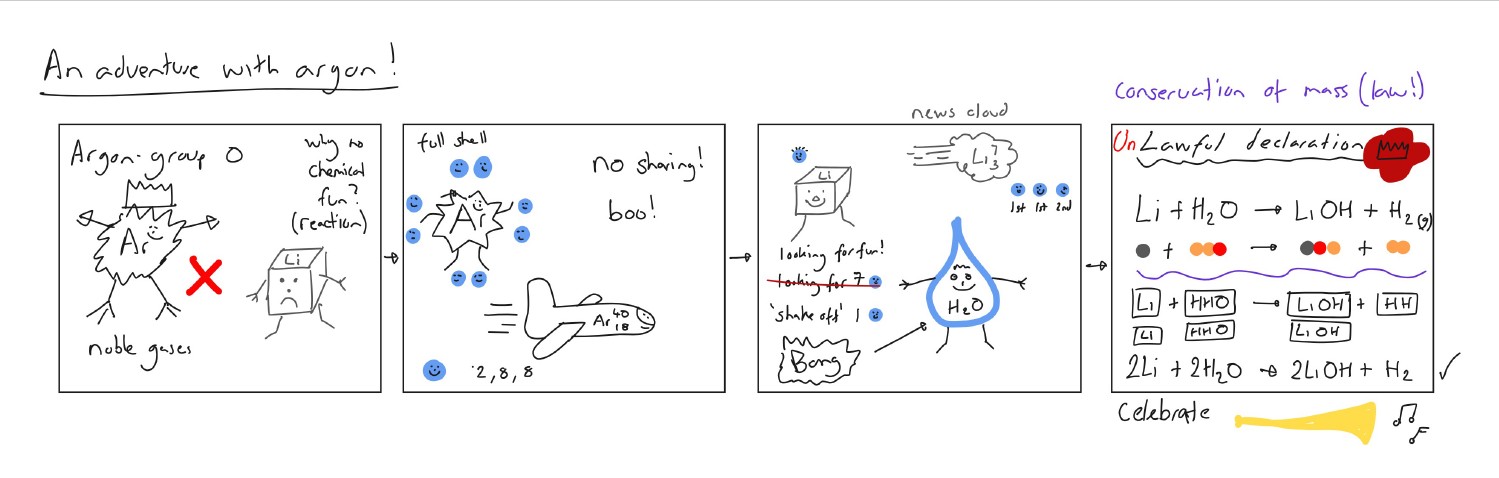
During a 1:1 chemistry tutoring session, we explored noble gases, electron shells, and chemical reactions through a simple hand-drawn comic about Argon. Instead of passively reading notes or memorising equations, the student transformed the concepts into characters and a story. Argon became the calm, emotionally unavailable noble gas with a full electron shell and no interest in reacting, while Lithium was portrayed as an impulsive chaos-agent desperately trying to lose its outer electron.
What followed was a surprisingly memorable chemistry lesson.
Turning Chemistry into a Story
Part of the comic evolved into a dramatic mini-story:
“Argon stood dramatically on a tiny atomic hill, wind blowing through his perfectly stable electron cloud.
‘I am complete,’ he declared. ‘Eight electrons. Full shell. Inner peace.’
Meanwhile, Lithium sprinted through the atomic neighbourhood screaming:
‘WHO WANTS TO REACT?!’
Moments later, Lithium collided with water.
BOOM!
‘This feels like a bad idea,’ Lithium said.
‘It is,’ replied Water.”
While playful, the student had embedded several important chemistry concepts into the story:
- Argon’s full outer electron shell and inert behaviour
- Lithium’s tendency to lose an electron
- The violent reaction between lithium and water
- The formation of lithium hydroxide and hydrogen gas
- Conservation of mass through balancing chemical equations
By translating the science into narrative and imagery, the student was forced to think carefully about why these reactions occur rather than simply memorising isolated facts.
The result was a session that felt less like revision and more like collaborative problem-solving.
“Imagine reacting.”
- Argon, completely unbothered noble gas
Learning Happens Through Translation
One of the most interesting parts of the session was that the student was not simply revising chemistry facts - they were translating scientific concepts into narrative, emotion, imagery, and behaviour.
That process matters.
To make Argon “emotionally unavailable,” the student had to understand what a full outer electron shell actually means. To make the Lithium-water explosion funny, they had to think about why lithium reacts so violently in the first place.
This kind of translation forces deeper cognitive processing than passive note-taking or rereading ever can. Students are no longer copying information; they are reconstructing meaning.
In many cases, this is where genuine understanding begins.
Dual Coding in Action
This is a strong example of dual coding in practice.
Dual coding theory suggests that learning becomes more effective when information is processed through both verbal and visual channels simultaneously. Instead of relying purely on text or speech, learners combine words, diagrams, symbols, sketches, movement, and storytelling to build richer mental models and stronger memory pathways.
Research into “the drawing effect” consistently shows that drawing improves retention compared to simply rewriting notes because it combines visual, semantic, and motor processing into a single activity.
Importantly, the quality of the drawing does not matter.
The sketches from this session were quick, messy, and funny - exactly as they should be. The educational value came from the act of generating meaning through drawing. To explain why Argon does not react, the student had to understand electron configurations. To make the Lithium-water explosion funny, they had to think about the chemistry behind the reaction itself.
This kind of active processing is fundamentally different from passive revision.
Why Humour and Creativity Matter
There was another important ingredient in the session: emotional engagement.
The student laughed throughout the activity. The chemistry became personal, absurd, and memorable. Argon refusing to “share” electrons is much easier to remember than a bullet point stating that “noble gases are inert.”
Humour and creativity help strengthen encoding and recall because they create emotional hooks attached to the information. The student was effectively teaching the concept back through the comic itself, combining retrieval practice, explanation, visualisation, and storytelling in one exercise.
What emerged was not just better recall, but deeper understanding.
The Power of 1:1 Learning
This kind of interaction is one of the greatest strengths of high-quality 1:1 tutoring.
A tutor can adapt in real time, spot misconceptions immediately, encourage creativity, and turn difficult concepts into collaborative thinking exercises. Learning becomes active rather than transactional.
In this session, the chemistry concepts stopped being abstract textbook material and became characters, behaviours, reactions, and stories the student could reason about intuitively.
That shift matters.
Students often struggle not because concepts are inherently too difficult, but because the material never becomes meaningful or cognitively connected.
Scaling Personalised Learning
At SideCog, our goal is to make more of these moments possible.
By the end of the session, the student could explain why Argon does not react rather than simply recalling that it does not.
We believe learning should feel engaging, creative, and human - not just efficient. The challenge is scaling the kind of personalised, responsive support that makes sessions like this so effective.
By combining strong pedagogy, retrieval practice, visual thinking, and accessible tutoring experiences, SideCog can help more students move beyond memorisation and towards genuine understanding.
Sometimes that starts with nothing more complicated than a badly drawn Argon atom refusing to react with anybody.
Written by
Julian Dance
Related articles
- SideCog Shorts | I want to help my child with revision, but I don’t know how.
Help your child revise without needing to know every answer. Join Julian for four practical 15-minute sessions on getting started, asking useful questions, trying better techniques and noticing progress.
28 September 2026
- Why Go and Revise So Often Ends in an Argument
What two decades in classrooms have taught me about why teenagers struggle to start revising and how parents can help
24 September 2026
- AI Can Answer a Question, But Can It Teach?
AI can answer questions, but can it teach? Discover why SideCog puts pedagogy, adaptive teaching and lasting learning at the heart of educational AI.
22 September 2026
- Can Attendance and Behaviour Really Be Linked in an Ofsted Report?
When a school has excellent behaviour but still receives a “Needs Attention” judgement because of attendance, it raises an important question: how much can schools really control? After 20 years in education, Julian Dance reflects on attendance, curriculum relevance and whether we need to look more closely at why some young people disengage from learning.
8 September 2026