
The Drawing Effect in Learning: How Sketching and Feedback Improves Memory and Understanding
By Julian Dance - Head of Big Ideas at SideCog.
The Drawing Effect: Why Sketching Drives Higher-Order Learning
In education, the idea of Learning Styles (visual, auditory, kinesthetic) has long been popular. However, research has consistently shown that matching instruction to a preferred style does not meaningfully improve learning outcomes.
What has emerged instead is a more robust framework: Dual Coding Theory.
At its core, Dual Coding suggests that learning improves when we combine verbal information with visual representations. And one of the most powerful ways to do this isn’t by viewing diagrams - it’s by drawing them.
This matters because, as explored in https://sidecog.com/blog/everything-in-education-comes-back-to-memory, learning ultimately depends on how well information is encoded and retrieved from memory.
Why the Brain Benefits from Drawing
When you read text alone, you encode information primarily in a verbal format. But when you draw, you create multiple retrieval pathways - linking language, structure, and spatial reasoning.
This isn’t about artistic skill. It’s about forcing the brain to organise and reconstruct knowledge.
The more structured that knowledge becomes, the more it contributes to connected knowledge—where ideas are not isolated, but meaningfully linked (explained here: https://sidecog.com/blog/why-connected-knowledge-matters-more-than-ever-in-education).
The Drawing Effect: A Generative Advantage
Research on the “Drawing Effect” (Wammes, Meade, & Fernandes, 2016) shows that drawing can outperform:
writing notes
passively viewing diagrams
mental visualisation
The reason is simple: drawing is generative. You are not consuming information - you are producing a structured representation of it.
This aligns closely with the idea that knowledge isn’t just stored; it actively shapes how students think (explained here: https://sidecog.com/blog/why-knowing-more-changes-how-students-think-and-learn)
Why Drawing Is a Higher-Order Skill
1. Selection and prioritisation - You must decide what matters. That requires abstraction, not copying.
2. Verbal-to-spatial translation - Cognitive offloading
Turning 'potential difference' into a circuit diagram requires real understanding.
Drawing acts as an external workspace, reducing load on working memory and enabling more complex reasoning.
This is particularly important given the limits of attention and working memory, as discussed in https://sidecog.com/blog/are-you-paying-attention.
The Missing Piece: Feedback
Despite its benefits, drawing has historically been underused in classrooms for one critical reason:
It doesn’t scale.
A teacher can quickly mark multiple-choice answers, but reviewing 30 hand-drawn diagrams for conceptual errors is slow and inconsistent.
This creates a feedback gap:
Students generate work
Errors go uncorrected
Misconceptions become embedded
Without feedback, even powerful strategies like drawing lose much of their impact.
This is why a https://sidecog.com/blog/why-diagnosis-first-learning-changes-everything approach is so important-learning improves when we identify misunderstandings early and precisely.
Closing the Feedback Gap
This is where things change.
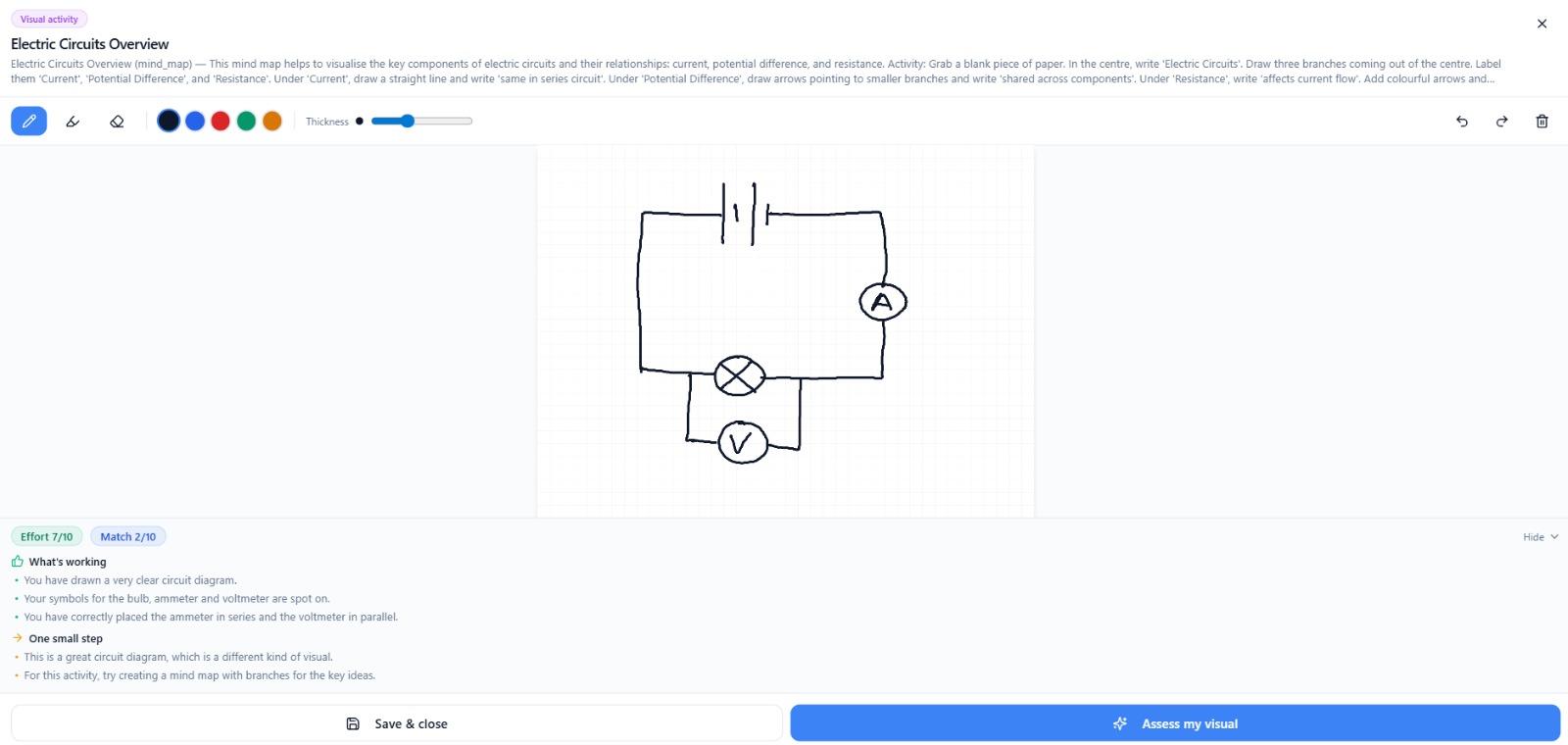
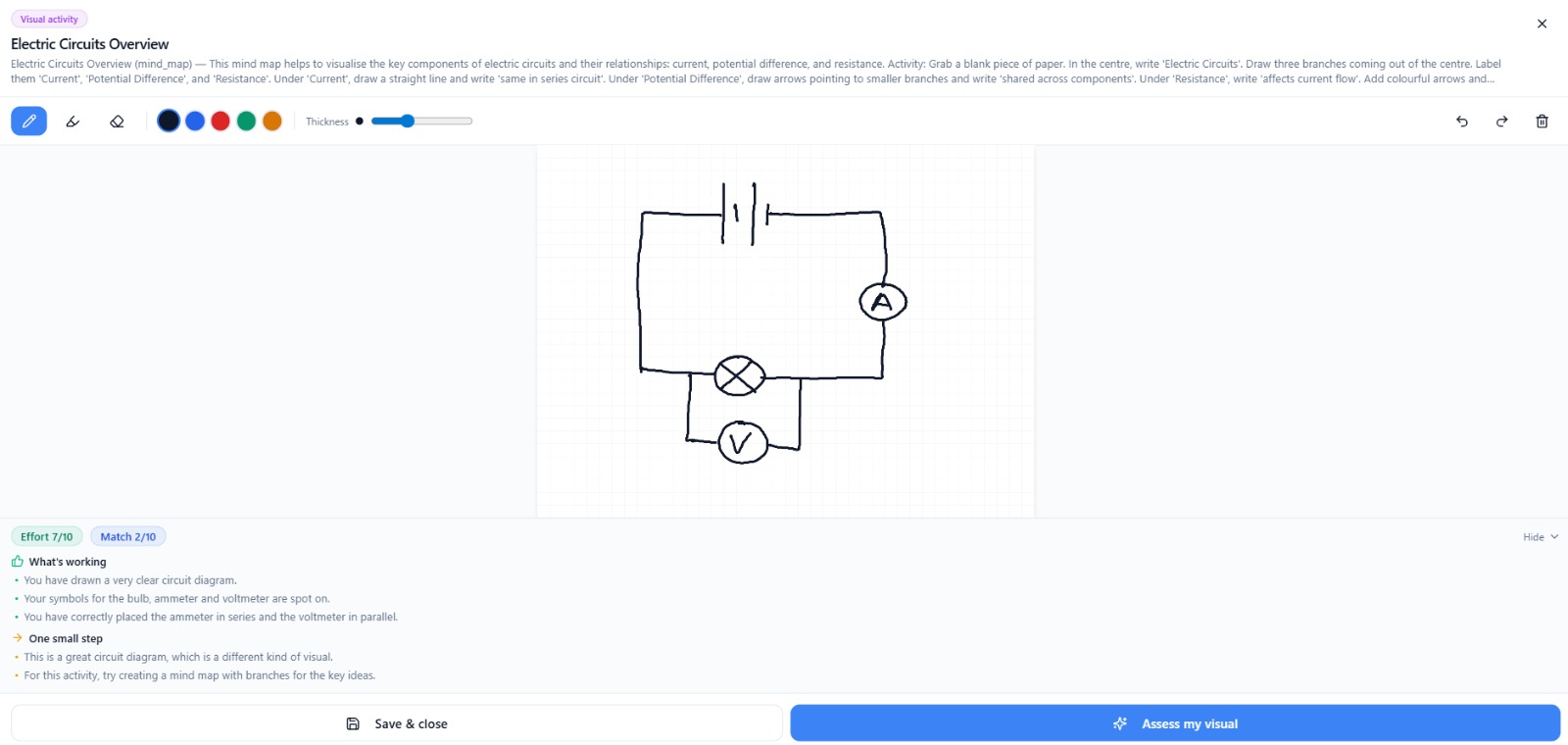
Sidecog now allows students to draw answers digitally and receive immediate, targeted feedback.
Here’s a real example of a student response being assessed:
In this example, the student has drawn:
a clear series circuit
correct symbols for the battery, bulb, ammeter, and voltmeter
a voltmeter correctly placed in parallel
The system evaluates not just the drawing, but the relationships between components.
It then provides structured feedback:
Confirms what is correct (circuit structure, symbols, layout)
Identifies what’s missing (the required mind map structure)
Suggests a clear next step (add central idea and branches)
This reflects a shift toward more effective teaching principles, similar to those outlined in https://sidecog.com/blog/making-every-lesson-count-6-principles-that-improve-science-teaching.
Why This Changes the Role of Drawing
Without feedback, drawing can reinforce incorrect understanding.
With immediate feedback, it becomes a closed learning loop:
Generate a representation
Receive precise correction
Refine understanding
This process directly supports metacognition-students thinking about and improving their own understanding-as explored in
https://sidecog.com/blog/metacognition-the-learning-habit-that-helps-your-child-make-real-progress.
This is important because...
The real breakthrough is not just digital drawing, it’s the combination of:
Generative learning (drawing)
Immediate feedback
Together, they:
strengthen encoding
reduce misconceptions
accelerate mastery
Crucially, this moves learning beyond passive activities-addressing the limitations highlighted in https://sidecog.com/blog/why-practical-work-alone-doesnt-teach-science.
When Drawing Doesn’t Help
Drawing is powerful-but not universal.
It can be less effective when:
learners lack sufficient prior knowledge
tasks are purely procedural
drawings become overly complex and increase cognitive load
Like any strategy, it must be used deliberately.
The Takeaway
Drawing is not about making learning more visual - it’s about making it more active, structured, and generative.
But its full potential is only realised when paired with immediate feedback.
That’s when learners don’t just express what they know - they improve it in real time.
Written by
Julian Dance
Related articles
- “My child is struggling, but I don’t know how to help”
You can see your child is struggling, but where do you start? Research shows why interested conversations matter during the GCSE years, and how clearer learning insights can help parents offer focused support.
1 October 2026
- Why Go and Revise So Often Ends in an Argument
What two decades in classrooms have taught me about why teenagers struggle to start revising and how parents can help
24 September 2026
- AI Can Answer a Question, But Can It Teach?
AI can answer questions, but can it teach? Discover why SideCog puts pedagogy, adaptive teaching and lasting learning at the heart of educational AI.
22 September 2026
- Can Attendance and Behaviour Really Be Linked in an Ofsted Report?
When a school has excellent behaviour but still receives a “Needs Attention” judgement because of attendance, it raises an important question: how much can schools really control? After 20 years in education, Julian Dance reflects on attendance, curriculum relevance and whether we need to look more closely at why some young people disengage from learning.
8 September 2026