
The Misconceptions That Can Follow a Child Into Adulthood
By Julian Dance, Head of Big Ideas at SideCog.
Most parents assume that if a child can remember the right answer, learning has happened.
But education research has shown for decades that recall and understanding are not the same thing.
A child can recite facts, pass tests, and still carry a deeply flawed mental model of how the world works.
And once those flawed models take hold, they do not stay neatly inside one science topic. They spread. They distort future learning. They affect confidence, reasoning, and a child’s ability to connect ideas across the curriculum.
One of the clearest examples is a misconception many adults still carry today:
Heavier objects fall faster than lighter ones.
At first glance, it sounds harmless.
It isn’t.
Why children believe it
Children observe the world carefully.
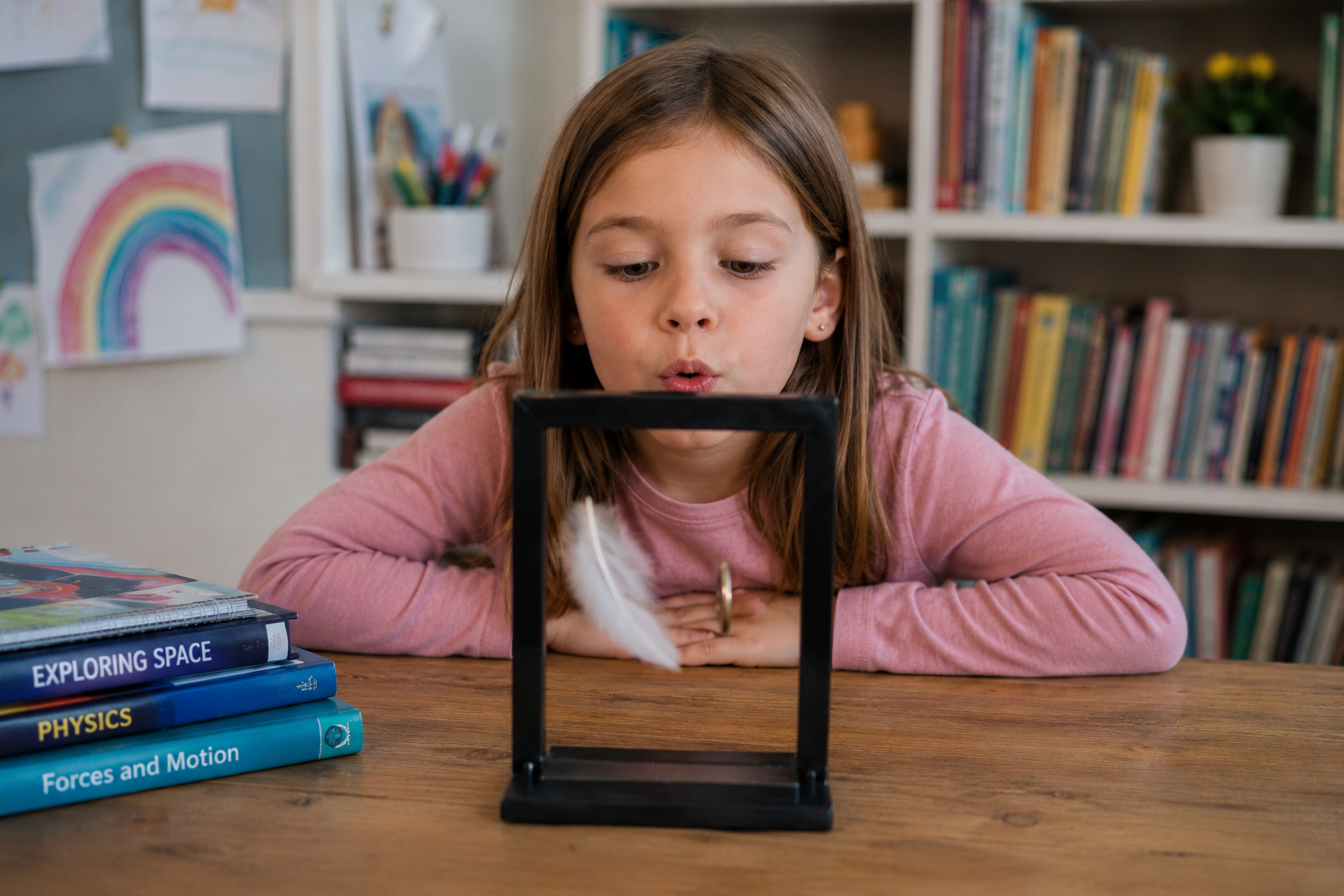
A stone falls faster than a feather. A heavy book hits the floor harder than a sheet of paper. A crumpled ball of paper drops faster than a flat one.
So children build a logical conclusion:
Heavier means faster falling.
From their perspective, this is rational.
The issue is that they are observing two things at once:
- gravity,
- and air resistance.
Without explicit conceptual understanding, the brain builds the wrong explanatory model.
This matters because children are not just collecting facts in school. They are constructing internal frameworks for how reality behaves.
And once those frameworks settle in, they become surprisingly resistant to change.
The research is remarkably clear
For more than forty years, science education researchers have studied what are called “misconceptions” or “naïve theories” - intuitive explanations children develop before formal instruction.
In the UK, research from the Education Endowment Foundation has consistently highlighted that durable learning depends on pupils making meaningful connections between ideas rather than simply rehearsing isolated facts. Their work on metacognition and self-regulated learning emphasises that pupils need to actively think about how and why concepts work if understanding is to transfer across subjects.
That distinction is enormously important.
If education focuses only on recall, children may learn the correct answers while still retaining the incorrect model underneath.
Researchers repeatedly found that students could reproduce equations and definitions while continuing to reason incorrectly about force, motion, energy, electricity, evolution, or matter.
In other words:
memorisation can mask misunderstanding.
And because misconceptions often feel intuitively true, they are highly persistent.
This aligns closely with findings from Ofsted, whose science subject reports repeatedly stress that superficial coverage and memorisation leave pupils unable to apply scientific knowledge in unfamiliar contexts. Their reviews argue that secure understanding depends on helping pupils connect ideas through explanation, practical reasoning, and discussion.
Research reviewed by the Education Endowment Foundation also shows that classroom dialogue, explanation, and metacognitive reflection produce stronger long-term learning than passive reception of information alone. Pupils learn more effectively when they are required to explain, justify, and revise their thinking.
In reality, many children are still being taught primarily for assessment performance rather than deep understanding - often because schools are under pressure, specialist teachers are in short supply, and curriculum time is increasingly compressed.
The result is that pupils frequently learn how to reproduce answers without fully understanding the concepts underneath them.
That gap between performance and understanding is exactly why a platform like SideCog has emerged: to help children build connected understanding, expose misconceptions early, and strengthen the reasoning skills that traditional test-driven learning often leaves behind.
This aligns with something many great teachers already know instinctively:
Children do not learn deeply by being told.
They learn deeply when they are forced to rethink.
Other misconceptions that quietly damage learning
The falling-objects misconception is only one example.
Education researchers and teachers regularly encounter misconceptions that follow children for years because they are never fully challenged.
Some of the most common include:
- Seasons happen because Earth is closer to the Sun in summer.
- Electricity gets “used up” as it travels around a circuit.
- Plants get their food from soil rather than mostly from carbon dioxide and sunlight.
- Humans only use 10% of their brains.
- Evolution is purposeful and organisms evolve because they “want” to adapt.
- Bigger fractions are always larger numbers, so 1/8 must be bigger than 1/4.
- Historical change happens because of one important person rather than interconnected causes.
- Mathematical formulas are rules to memorise rather than relationships to understand.
What makes these misconceptions important is not simply that they are technically incorrect.
It is that they distort future learning.
Children begin building new knowledge on unstable foundations.
And once learning becomes disconnected from understanding, many pupils start relying almost entirely on short-term memorisation to survive academically.
What parents can do differently
Parents do not need to become science experts.
But they can change the kinds of conversations they have.
Instead of asking:
“What did you get on the test?”
Try asking:
“Why does that happen?”
Or:
“How do we know that’s true?”
Or:
“What would happen if the opposite were true?”
Those questions develop something far more valuable than recall.
They develop intellectual flexibility.
And that flexibility matters everywhere:
- in science,
- in mathematics,
- in writing,
- in problem-solving,
- and eventually in adult decision-making.
The bigger lesson
The real goal of education is not storing information.
Information is everywhere.
The real goal is building accurate mental models of the world.
That is what allows children to transfer knowledge between subjects, solve unfamiliar problems, and think critically as adults.
A child who truly understands why objects fall at the same rate in a vacuum has learned something much larger than a physics fact.
They have learned that intuition can be wrong.
They have learned that evidence matters.
And they have learned that understanding is something deeper than remembering.
That lesson may be one of the most important things education can give them.
Further reading
- Education Endowment Foundation: Metacognition and Self-Regulated Learning
https://educationendowmentfoundation.org.uk/education-evidence/teaching-learning-toolkit/metacognition-and-self-regulation - Ofsted Science Research Review
https://www.gov.uk/government/publications/research-review-series-science/research-review-series-science - Education Endowment Foundation: Oral Language Interventions
https://educationendowmentfoundation.org.uk/education-evidence/teaching-learning-toolkit/oral-language-interventions - Royal Society: Vision for Science and Mathematics Education
https://royalsociety.org/topics-policy/projects/vision/ - British Science Association: CREST and Scientific Thinking
https://www.britishscienceassociation.org/crest-awards
Written by
Julian Dance
Related articles
- SideCog Shorts | I want to help my child with revision, but I don’t know how.
Help your child revise without needing to know every answer. Join Julian for four practical 15-minute sessions on getting started, asking useful questions, trying better techniques and noticing progress.
28 September 2026
- AI Can Answer a Question, But Can It Teach?
AI can answer questions, but can it teach? Discover why SideCog puts pedagogy, adaptive teaching and lasting learning at the heart of educational AI.
22 September 2026
- Can Attendance and Behaviour Really Be Linked in an Ofsted Report?
When a school has excellent behaviour but still receives a “Needs Attention” judgement because of attendance, it raises an important question: how much can schools really control? After 20 years in education, Julian Dance reflects on attendance, curriculum relevance and whether we need to look more closely at why some young people disengage from learning.
8 September 2026
- What Trying to Speak Italian Taught Me About Learning
A 658-day Duolingo streak doesn't necessarily make you confident enough to order dinner. A family holiday in Sardinia got Julian thinking about context, confidence, retrieval - and the difference between completing activities and actually learning.
27 August 2026