
“My child is struggling, but I don’t know how to help”
You can usually tell when your child is finding school difficult. They spend an evening revising but cannot say what they have learned. A test result comes home lower than expected. Or they tell you they are “just bad” at a subject they used to enjoy.
You want to help. But GCSE subjects have changed since you took them, the exam boards have different requirements, and “go and revise” rarely tells a teenager what to do next. If you ask what they are stuck on, they may genuinely not know. It is tempting to wait for a report or parents’ evening to tell you whether something is wrong. As I explored in what parents really want to know beyond parents’ evening, by then a difficulty may have been there for weeks.
After twenty years in the classroom, I have seen how easily a small gap can hide behind a broad label such as “struggling with science”. A student may recall the definition of a circuit component but think that current gets used up as it travels around a circuit. More practice with definitions will not correct that misunderstanding. First, somebody has to find it.
Taking an interest is part of the support
There is good reason to take an active interest in your child’s education throughout secondary school. A Department for Education review of research on secondary pupils reports that parental interest at age 14 was associated with a greater likelihood of achieving five or more GCSEs at the former A*–C benchmark, including English and maths, at age 16. In the study it reviewed, interest meant talking with children about their schoolwork, experiences at school and GCSE subject choices. It was something parents did, not simply something they felt.
A review of 50 studies of early adolescents found that parental involvement was generally associated with achievement. The strongest relationship was with what researchers call academic socialisation: talking about why learning matters, discussing strategies, encouraging aspirations and connecting schoolwork with a young person’s interests and plans. Direct help with homework was the exception; it did not show the same positive association. These studies show a relationship, not that an individual conversation will cause a particular GCSE grade.
Taking ownership, then, does not mean taking over your teenager’s revision or waiting for the school to direct every step. It means staying curious: knowing what they are studying, asking how it is going, noticing when their confidence or progress changes and helping them find the right support. A short, interested conversation can be more useful than another reminder to work harder.
Parents can make a difference when they know what to act on
The Education Endowment Foundation (EEF) review of parental engagement finds an average of around four additional months of progress for the approaches it studied. That is a finding across different programmes, not a promise that any particular app will add four months to a GCSE student’s learning. Much of the research concerns younger children and reading; there is less robust evidence for secondary school pupils.
There is, however, a useful secondary school example. In an EEF trial involving nearly 16,000 pupils, parents received messages about learning, tests and homework. The evaluation found a small positive effect on maths attainment, equivalent to roughly one additional month of progress, alongside reduced absence. Information did not turn those parents into maths teachers. It gave them more specific opportunities to talk and act.
That distinction matters. The EEF also cautions that getting parents more directly involved in homework has not generally been linked to higher attainment, particularly when the subject knowledge and teaching methods are unfamiliar. A parent’s most helpful role may be to notice a pattern, support a manageable plan, encourage their child and bring a specific concern to a teacher when needed. Schools remain essential partners; as I have written about in the limits of one teacher’s capacity to respond to every learner, parents need not sit back until a formal report arrives to begin that conversation.
“They need to work harder” is rarely a diagnosis
A low mark tells you that something needs attention. It does not tell you whether your child:
- has never securely learned an earlier idea;
- has learned an idea incorrectly;
- understands the content but struggles to apply it to an unfamiliar question; or
- knows how to answer but rushes, loses confidence or misreads the task.
Each calls for a different response. Repeating the same worksheet may help with fluency, but it is unlikely to fix a misconception that the learner cannot yet see. A conversation about motivation will not teach a missing scientific idea.
This is why the EEF places such weight on checking understanding and giving feedback that learners can act on. Useful assessment reveals what a pupil is thinking; useful feedback helps decide the next step. The EEF’s review of individualised instruction likewise identifies accurate assessment of gaps, well-matched activities and feedback as important ingredients. The evidence supports these principles; it does not establish the impact of SideCog itself.
From a vague worry to a useful next step
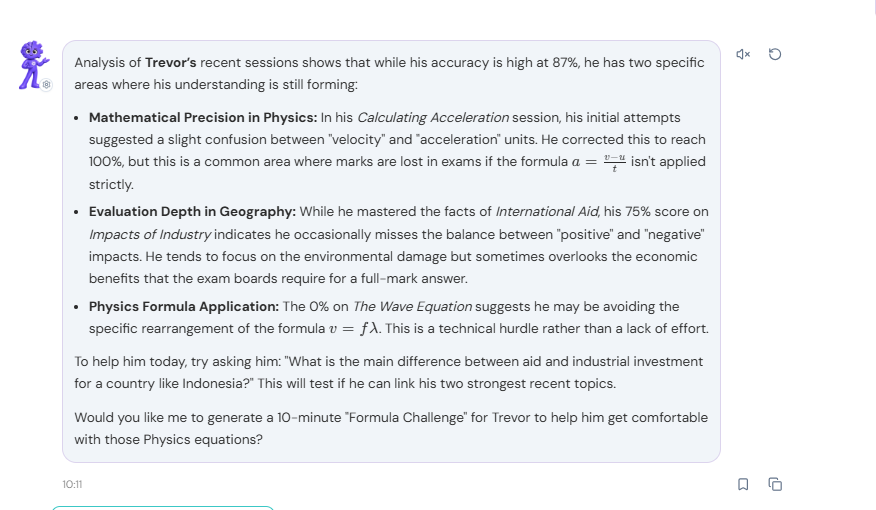
Imagine a parent opening a progress view and seeing 87% overall accuracy. It sounds reassuring. Yet the detail points to three things worth looking at: some uncertainty over velocity and acceleration units in physics, a very low result on the wave equation, and a geography answer that may need a better balance of positive and negative impacts. A single overall figure would not tell that parent where to start.
Those observations turn into useful prompts. “Can you explain why acceleration has different units from velocity?” “Shall we work through one wave-equation question together?” “What economic benefit could you add to your answer about industry?” A parent can show interest and help their child choose one next step without knowing the whole specification. If the issue continues, they can bring a precise question to the teacher.
A percentage on one activity cannot answer all of that on its own. A low score does not prove that a child is avoiding a topic, and a corrected answer does not prove that an idea is secure. Responses over time, the types of mistakes made and a conversation with the learner give a better picture. Then support can become specific: revisit the relevant explanation, try a question that tests the reasoning, and return to it later to check whether the understanding holds.
The conversation at home changes too. Instead of “Have you revised?”, you can ask, “I can see this topic has been tricky. Which part is making less sense?” Or, “Shall we choose one thing to work through today?” You do not need to know every correct GCSE answer to ask either question. What matters is that your child knows you are interested and that there is a sensible next step when they get stuck.
How SideCog helps parents support GCSE learning
In SideCog, a learner’s profile is set up around their subjects, exam boards and target grades. That gives their work a relevant starting point. As they complete diagnostics and learning activities, SideCog looks for gaps, misconceptions and areas that need more practice. Cogsy, the learning companion, guides the child through explanations and questions, adapting the next step to what their responses show rather than simply supplying an answer.
The parent view makes that learning visible. It shows what is becoming secure, what still needs attention and what the learner is working on next. These are prompts for the conversations research suggests matter: “You seem confident on this topic. What helped?” “This one keeps coming up. What feels difficult?” “Would it help to work through the lesson or ask your teacher?” The aim is to help a parent move from “Something is wrong, but I can’t put my finger on it” to “I know what to ask about and how to support the next step.”
No dashboard can tell you everything about a child. A short run of questions is a signal to investigate, not a fixed judgement of ability, a prediction of a GCSE grade or a substitute for their teacher. The value lies in combining clearer insight with the child’s own experience and an appropriate next action.
A practical way to help this week
Start with one subject, not the entire revision timetable. Look for a particular topic or type of question that repeatedly causes difficulty. Ask your child what they think is happening. Let them work through a relevant explanation and a few questions, then come back to the idea later. Notice what improved as well as what remains difficult.
That is parental engagement a teenager can use: attention without a lecture, encouragement without guesswork, and support aimed at the learning that will make the next piece of work easier. It gives parents a more active role while leaving the teenager room to think, practise and make progress for themselves.
If you are thinking, “My child is struggling, but I don’t know how to help,” start with SideCog’s free five-minute diagnostic. It can give you both a clearer question to ask and a place to begin.
Written by
Rachel Dance
Related articles
- SideCog Shorts | I want to help my child with revision, but I don’t know how.
Help your child revise without needing to know every answer. Join Julian for four practical 15-minute sessions on getting started, asking useful questions, trying better techniques and noticing progress.
28 September 2026
- Why Go and Revise So Often Ends in an Argument
What two decades in classrooms have taught me about why teenagers struggle to start revising and how parents can help
24 September 2026
- Can Attendance and Behaviour Really Be Linked in an Ofsted Report?
When a school has excellent behaviour but still receives a “Needs Attention” judgement because of attendance, it raises an important question: how much can schools really control? After 20 years in education, Julian Dance reflects on attendance, curriculum relevance and whether we need to look more closely at why some young people disengage from learning.
8 September 2026
- What Trying to Speak Italian Taught Me About Learning
A 658-day Duolingo streak doesn't necessarily make you confident enough to order dinner. A family holiday in Sardinia got Julian thinking about context, confidence, retrieval - and the difference between completing activities and actually learning.
27 August 2026