
Can Attendance and Behaviour Really Be Linked in an Ofsted Report?
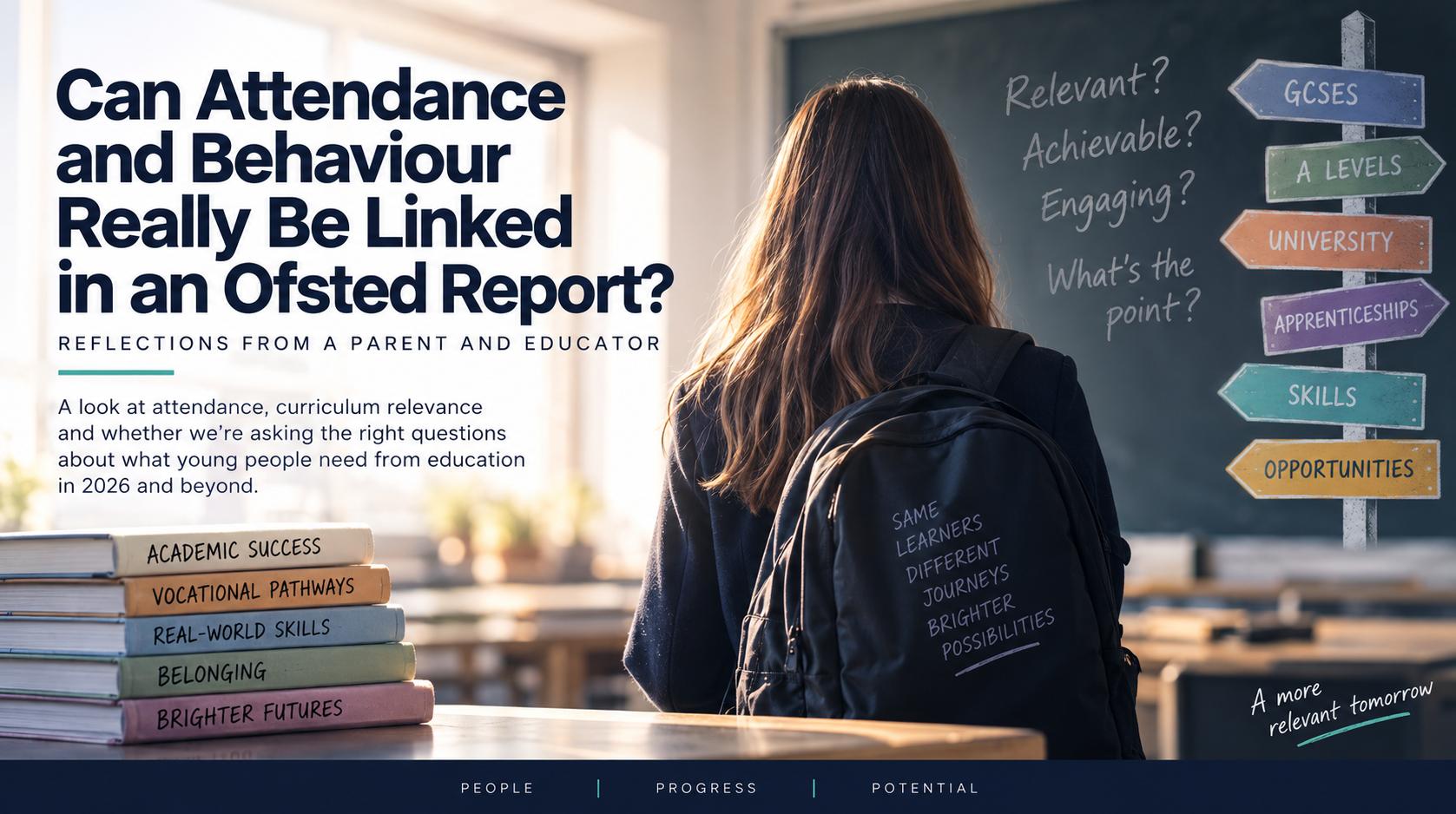
My daughter attends a local secondary school which has just received its Ofsted report following an inspection in July.
It is a great school that does wonderful things for young people. It is inclusive, offers high-quality teaching, and my daughter comes home feeling part of something quite special. Teachers work hard to develop and deliver a curriculum that ensures knowledge and skills are built consistently across the five years children are at the school. Progress is good, outcomes are strong, and children leave prepared for young adult life and ready to take their next steps.
The recent report, however, highlighted an issue with attendance and behaviour, grading this area as “Needs Attention.”
What struck me was that the report itself described behaviour extremely positively. It talked about leaders embedding a highly respectful culture, with well-focused behaviour routines maintained consistently by staff, resulting in a calm and focused learning environment.
In other words, the behaviour sounded like something most schools would be delighted to achieve.
The “Needs Attention” judgement resulted instead from disadvantaged pupils not attending school as frequently as they should.
And that made me wonder: should attendance and behaviour really sit together in the same judgement?
What can schools actually control?
Having worked in schools for more than 20 years, including being deeply involved with behaviour, I have spent a lot of time thinking about what schools can, and cannot, control.
Ultimately, you cannot control how a young person behaves. What you can do is create the right culture, establish clear expectations and help young people make better choices.
Writers such as Bill Rogers and Paul Dix had a significant influence on my own approach. For me, effective behaviour management was never primarily about punishment. It was about helping young people reflect on what happened, understand the consequences of their actions and recognise that there might have been a different way to respond.
Schools therefore have considerable influence over behaviour. They can create environments, relationships and routines that make positive behaviour much more likely.
Attendance feels different.
How much can a school leadership team, staff body, governors or trustees actually control whether a young person walks through the school gates each morning?
Of course schools have a responsibility to encourage attendance, identify problems early and work with families. But many of the reasons young people stop attending school are complex and sit far beyond the direct control of a school.
Family circumstances, mental health, social pressures, poverty, caring responsibilities and a host of other factors can all play a part.
But I also wonder whether there is another factor we don't examine closely enough.
The experience of learning itself.
What happens when learning stops feeling relevant or achievable?
I think we need to be willing to ask whether the curriculum, and perhaps more importantly, the way learners experience it, contributes to disengagement.
If a young person repeatedly encounters learning they do not understand, cannot see the relevance of, or increasingly believes they are simply “not good at”, it is perhaps unsurprising when their motivation to engage begins to disappear.
For me, this is an important distinction.
Engagement is not simply about making learning entertaining. It is about helping young people experience progress, understand why something matters and develop the confidence that they are capable of learning it.
When those things are missing for long enough, “What’s the point?” can become a perfectly understandable response.
I find myself questioning more and more how well our curricula reflect the world young people are preparing to enter.
How relevant is what we teach to their lives, the technology shaping their world, the decisions they will have to make and the opportunities available to them?
In some respects, I don't think our current curriculum is fit for purpose.
Are we still designing education around one definition of success?
At times, our education system can feel heavily academically focused, perhaps operating under the assumption that there is one principal route through education: GCSEs, A levels, university and ultimately a professional or academic career.
Having taught in schools with vastly different contexts, I know that route isn't right for every young person. Nor should it be.
Around ten years ago, I was involved in setting up BTEC vocational programmes within secondary schools, giving young people opportunities to develop skills connected to areas such as hairdressing, beauty, plumbing, mechanics and construction.
For some learners, those opportunities transformed their relationship with education and enabled them to move successfully into important trades and professions where skilled people remain desperately needed. Sadly in many schools, qualifications are no longer part of the curriculum due to the pressures of performance measures schools find themselves hostage to.
Perhaps part of the problem is that we still expect too many young people to adapt themselves to the education system, rather than asking how education can adapt more effectively to them.
Learners arrive with different starting points, gaps in knowledge, misconceptions, levels of confidence, interests and ambitions. Yet much of secondary education necessarily moves them through the same curriculum, at broadly the same pace, towards the same measures of success.
That tension has increasingly shaped my own thinking about education. How do we retain high expectations and a rigorous curriculum, while making learning more responsive to the individual sitting in front of us?
Could technology help us do some of this differently?
It is one of the reasons I became increasingly interested in what technology might allow us to do differently.
This thinking ultimately contributed to why we built SideCog, to explore whether learning can become more responsive to what an individual learner actually understands, where they are struggling and what they need next.
Technology cannot solve the wider social, cultural and personal factors behind school absence, and I would never suggest that it can.
But if we can help more young people experience learning as something they can understand, make progress in and ultimately succeed at, perhaps that is one small part of the much bigger engagement puzzle.
Schools undoubtedly have a responsibility to tackle persistent absence. But I think we also have to be realistic about the limits of their influence and be willing to look more deeply at why some young people disengage from education in the first place.
That includes being prepared to look inward and ask difficult questions about the curriculum, the experience of learning and whether what happens in school every day feels relevant and achievable to all of the young people we are so desperately trying to encourage to attend.
My daughter's school appears to have created something many schools strive for, a respectful culture, strong teaching and a calm, focused learning environment.
Yet fantastic behaviour was grouped together with poor attendance and resulted in a “Needs Attention” judgement.
As both a parent and an educator, I struggle with that.
Perhaps the bigger question isn't simply how we get young people to attend school more often.
Perhaps we also need to ask whether the education we are asking them to attend is evolving quickly enough to meet their needs.
Learning that responds to the learner
Questions about engagement, confidence and individual learning needs are part of what led us to build SideCog.
SideCog is a personalised teaching platform for learners aged 11–16, built by experienced teachers and aligned to the UK curriculum and GCSE exam boards. It works to understand what a learner actually knows, identify gaps and misconceptions, and adapt what happens next.
Further reading
Are you revising or just copying?
Adaptive teaching was never the problem. Capacity is.
Guided Learning and AI. What the evidence says about how students learn best.
Written by
Julian Dance
Related articles
- “My child is struggling, but I don’t know how to help”
You can see your child is struggling, but where do you start? Research shows why interested conversations matter during the GCSE years, and how clearer learning insights can help parents offer focused support.
1 October 2026
- SideCog Shorts | I want to help my child with revision, but I don’t know how.
Help your child revise without needing to know every answer. Join Julian for four practical 15-minute sessions on getting started, asking useful questions, trying better techniques and noticing progress.
28 September 2026
- AI Can Answer a Question, But Can It Teach?
AI can answer questions, but can it teach? Discover why SideCog puts pedagogy, adaptive teaching and lasting learning at the heart of educational AI.
22 September 2026
- What Trying to Speak Italian Taught Me About Learning
A 658-day Duolingo streak doesn't necessarily make you confident enough to order dinner. A family holiday in Sardinia got Julian thinking about context, confidence, retrieval - and the difference between completing activities and actually learning.
27 August 2026