
Why Connected Knowledge Matters More Than Ever in Education
By Julian Dance, Head of Science & Head of Big Ideas at SideCog
After more than fifteen years in state secondary schools, one conviction has only strengthened: great teaching changes lives.
Not gimmicks
Not shortcuts.
Not exam hacks.
Teaching that helps young people understand the world.
I have worked through curriculum reforms, accountability shifts, grading changes, and waves of educational “silver bullets”. The classrooms that genuinely thrive share one consistent feature: pupils are not just memorising content - they are connecting it.
And that distinction changes everything.
The Problem With Fragmented Learning
Too often, education is experienced as a checklist:
- Memorise this definition.
- Learn this formula.
- Practise this question type.
But for many - especially lower attainers, anxious learners, or those without academic scaffolding outside school - this approach creates knowledge that doesn’t hold up under pressure.
They “know” the material, yet cannot explain it.
They revise diligently, yet struggle when the context shifts.
They begin to believe they are “not academic”.
This is not a motivation problem.
It is a knowledge-structure problem.
What Is Connected Knowledge?
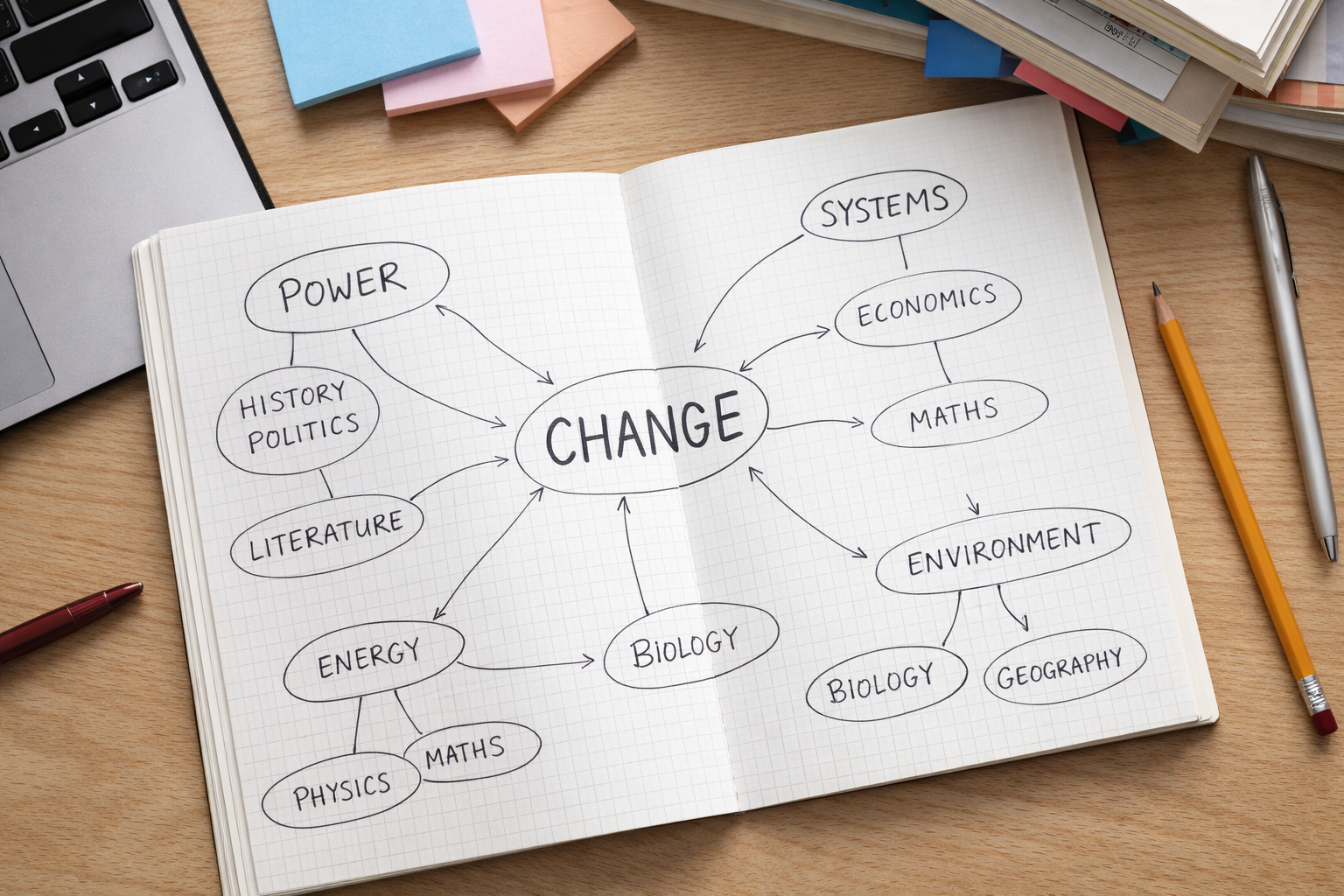
Connected knowledge refers to information organised into coherent mental frameworks - where ideas link, reinforce, and build upon one another.
Rather than isolated facts, pupils develop structured understanding.
Research in cognitive science is clear: knowledge stored within organised schemas is more deeply embedded, more transferable, and more usable than disconnected information.
Daniel Willingham demonstrates that thinking depends on background knowledge. Critical thinking is not a generic skill - it is domain-specific and rooted in what you already know.
John Sweller’s Cognitive Load Theory explains that fragmented instruction overloads working memory and prevents schema formation.
Barak Rosenshine emphasised the importance of sequencing learning carefully so that new material builds explicitly on prior knowledge.
E.D. Hirsch argues that shared knowledge underpins comprehension, equity, and academic success.
Wynne Harlen’s work on Big Ideas illustrates how powerful, organising concepts enable learners to make sense of large bodies of content.
Across disciplines, the principle is the same:
Memory strengthens when new knowledge has something meaningful to attach to.
Facts learned in isolation are far more likely to be forgotten
When ideas are connected, they are remembered for longer
Why Connected Knowledge Improves Thinking
When pupils develop connected knowledge:
They can explain ideas in their own words.
They spot patterns and relationships.
They apply learning in unfamiliar contexts.
They reason with confidence rather than guess.
This is what deeper learning looks like.
Transfer - the ability to use knowledge in new situations - depends on recognising underlying structure. Without structure, knowledge is hard to use.
In practical terms, this means a pupil who understands a concept can reconstruct answers logically, rather than search their memory for a memorised template.
That difference is decisive in examinations and beyond. Here's an example.
The Impact on Confidence and Motivation
I have worked with hundreds of students who believed they were “bad at school”. Often, the issue was not effort. It was coherence.
When learning feels disconnected, it feels overwhelming.
When ideas link together, they feel manageable.
Connected knowledge:
Reduces cognitive overload.
Builds intellectual confidence.
Encourages curiosity.
Increases long-term retention.
The shift in self-belief can be dramatic. Students who once relied on rote revision begin to reason independently. Anxiety decreases. Engagement increases.
Understanding changes how students see themselves and builds self-belief.
Why This Matters in the Age of AI
In a world where facts are searchable and answers are instantly accessible, knowledge is sometimes undervalued.
But the opposite is true.
External information is only useful if you possess internal structure. Having the answer isn’t the same as knowing why.
AI systems function through pattern recognition across interconnected data. Human cognition operates similarly: the richer and more interconnected your schema, the more powerful your reasoning.
Connected knowledge enables:
Critical evaluation
Informed decision-making
Creative problem-solving
Intellectual independence
Without it, learners remain dependent on prompts and templates.
The Equity Argument
Some pupils arrive at school with extensive background knowledge and support at home. Others do not.
When teaching relies on assumed connections, those differences grow and those less well supported students fall further behind.
A carefully sequenced, connected curriculum makes those links explicit. It gives every pupil access to the same conceptual foundations - not just those who happen to bring them with them.
What This Means for Curriculum Design
If connected knowledge matters, and the research strongly suggests it does, then curriculum design must prioritise:
Logical sequencing of ideas
Explicit connections between topics
Regular retrieval and revisiting
Explanation over surface coverage
Depth before acceleration
This requires subject expertise and long-term planning. It cannot be bolted on through revision sessions at the end of a course.
It must be built in from the beginning.
The Bottom Line
After fifteen years in the classroom, my view is straightforward:
When students understand how and why ideas connect - not just what to memorise - they become more capable thinkers.
They cope better with unfamiliar questions.
They study more independently.
They approach new challenges with greater confidence.
Building those connections requires more thinking. And thinking is what strengthens memory.
That is what makes learning last.
And that is what education should be for.
Written by
Julian Dance
Related articles
- Why Go and Revise So Often Ends in an Argument
What two decades in classrooms have taught me about why teenagers struggle to start revising and how parents can help
24 September 2026
- What Trying to Speak Italian Taught Me About Learning
A 658-day Duolingo streak doesn't necessarily make you confident enough to order dinner. A family holiday in Sardinia got Julian thinking about context, confidence, retrieval - and the difference between completing activities and actually learning.
27 August 2026
- Flashcards - Are You Revising or Just Copying?
Flashcards are one of the most popular revision tools, but using them badly can create the illusion of learning. Julian explores how to make them work harder.
10 August 2026
- Why We Can't Think in a Heatwave (And What It Teaches Us About Learning)
Britain's recent heatwave has left many of us saying the same thing: "I just can't think." But what if that experience reveals something important about how learning works? In this article, Julian explores the surprising parallels between cognitive performance in extreme temperatures and the challenges students face when misconceptions, knowledge gaps and cognitive overload get in the way of understanding.
24 June 2026