
Flashcards - Are You Revising or Just Copying?
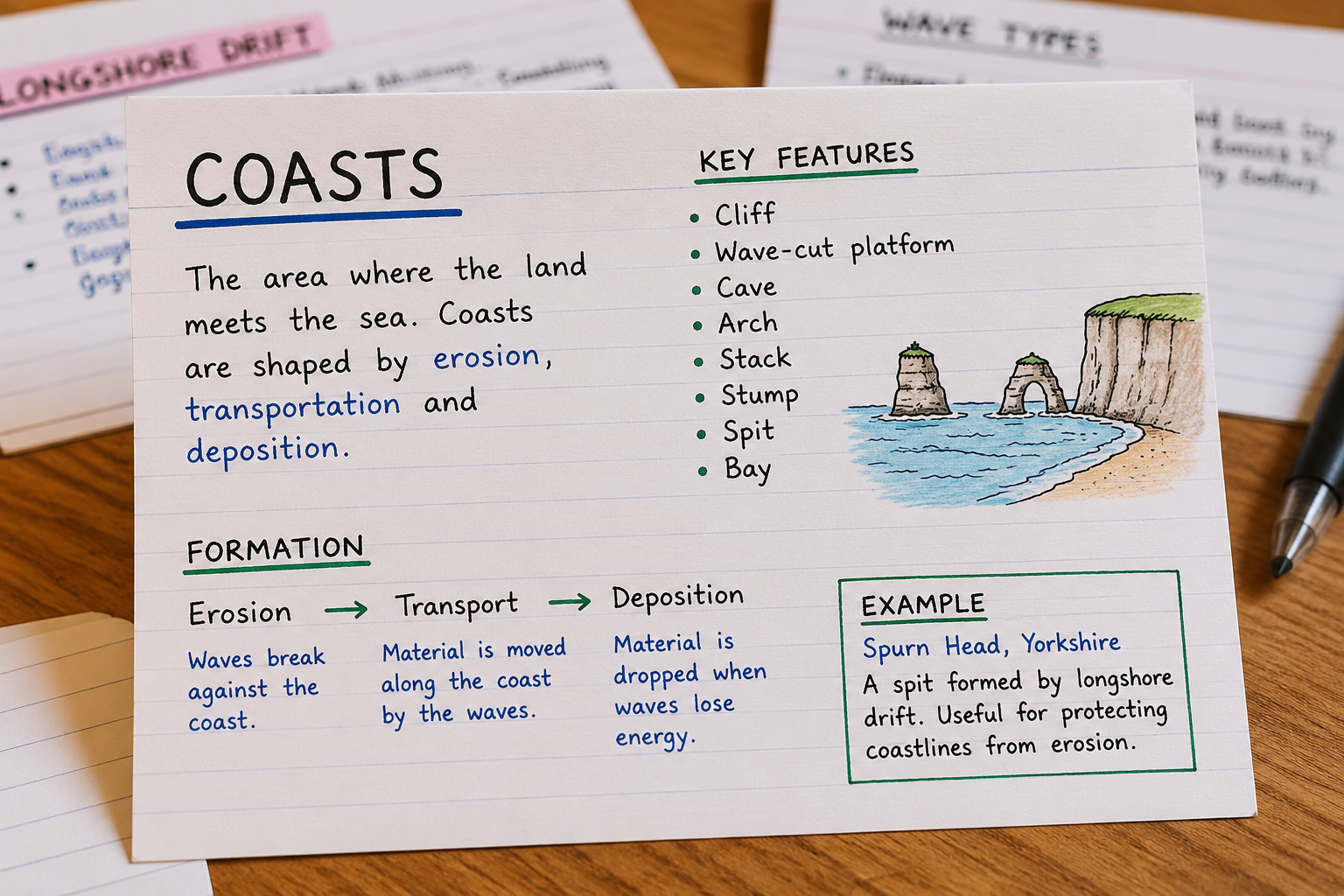
Flashcards are everywhere.
Walk into almost any GCSE revision session and you’ll find students surrounded by them. Keywords on one side. Definitions, dates, equations or facts on the other.
And they’ll often be working incredibly hard.
The problem is, working hard and learning effectively aren't necessarily the same thing.
I've watched students spend an hour carefully copying keywords from a textbook onto one side of a card, then copying the definition onto the other. They're focused. They're busy. It certainly feels like revision.
But how much learning is actually taking place?
The problem isn't flashcards
Let me be clear: I don't think flashcards are useless.
I think the way they're commonly used is.
GCSEs are content-rich. There are facts, dates, equations, definitions, vocabulary and processes that students simply need to know.
Flashcards can be useful for retrieving that information. But knowing a collection of facts isn't the same as understanding a subject.
And that's where the problem starts.
If I learn that the formula for glucose is C₆H₁₂O₆, I can probably answer a question that asks:
What is the formula for glucose?
Great. One mark.
But what happens when I'm asked to explain how glucose is used by a plant? Or compare different uses of glucose? Or apply my understanding of glucose to a situation I haven't seen before?
Suddenly, remembering C₆H₁₂O₆ isn't much help.
Exams don't always give you the cue you're expecting
Traditional flashcard revision often works through simple cues.
Front: Photosynthesis
Back: Definition of photosynthesis
Eventually, the learner becomes very good at associating one with the other.
The difficulty is that exam questions aren't necessarily going to present the information in exactly the same way.
Students can leave an exam saying: "There weren't any questions on the things I revised."
Often there were.
The questions just didn't look like the flashcards.
That's the difference between remembering something and being able to use it.
Good learning means building connections between ideas so that knowledge can be retrieved and applied in unfamiliar situations.
That's particularly important as questions become more demanding.
The higher-value answers are rarely just collections of remembered facts. They require students to connect ideas:
This happens because...
That causes...
If this changes, then I would expect...
Those connections are where understanding lives.
Stop copying. Start thinking.
So how can we make flashcards more useful?
The first change I'd make is very simple:
Don't copy the answer.
If you're creating a card about photosynthesis, don't find a definition online and carefully reproduce it word for word.
Read several explanations.
Look at your exercise book. Look at a revision guide. Look at another trusted resource.
Then close them and write your own explanation.
That small change makes the task significantly more powerful because you now have to decide what matters, organise the information and reconstruct the idea yourself.
You're thinking rather than transcribing.
Transform the information
We can go further.
Once you've retrieved what's on the flashcard, do something with it. For example:
- Turn the explanation into a diagram.
- Explain it without using the key word.
- Give an example.
- Connect it to another topic.
- Explain why it happens.
- Predict what would happen if one variable changed.
- Write a question that would require someone to apply the idea.
If you've got a card explaining photosynthesis, read it and then try to represent the process as a simple diagram with as few words as possible.
Now your brain has to reorganise the information.
That's much harder than simply reading a definition.
And that's the point.
Revision shouldn't always feel easy
One of the traps of revision is that familiarity feels like learning.
You read a flashcard for the fifth time and think: "Yep. I know that."
But recognising an answer when it's sitting in front of you is very different from being able to reconstruct and apply that knowledge independently.
Effective revision needs to make you think.
It should require you to retrieve, connect, explain, transform and apply what you know.
So I'm not suggesting you throw your flashcards away.
I'm suggesting you ask more of them.
If your revision consists of copying a keyword onto one side, copying a definition onto the other and reading it several times, the effort you're putting in probably isn't giving you the return you think it is.
Use the card as the starting point for thinking, not the end point of learning.
Because the aim isn't to remember what's written on a flashcard.
It's to understand the idea well enough that you can use it when the question in front of you looks nothing like the one you were expecting.
Further Reading
How Many Marks for Asparagus? Why Understanding Beats Memorisation - Why remembering the facts isn't necessarily the same as understanding them.
Everything in Education Comes Back to Memory - What learning science tells us about memory, retrieval and making knowledge stick.
The Drawing Effect in Learning - Why turning what you know into a drawing can strengthen understanding and memory.
Written by
Julian Dance
Related articles
- SideCog Shorts | I want to help my child with revision, but I don’t know how.
Help your child revise without needing to know every answer. Join Julian for four practical 15-minute sessions on getting started, asking useful questions, trying better techniques and noticing progress.
28 September 2026
- What Trying to Speak Italian Taught Me About Learning
A 658-day Duolingo streak doesn't necessarily make you confident enough to order dinner. A family holiday in Sardinia got Julian thinking about context, confidence, retrieval - and the difference between completing activities and actually learning.
27 August 2026
- How Many Marks for Asparagus? Why Understanding Beats Memorisation
A student labelled the oesophagus as "asparagus" and the bronchioles as "broccoli". Funny? Absolutely. But the story reveals something important about the difference between recall and genuine understanding.
16 June 2026
- Why Do Some Students Understand and Others Don't?
After nearly twenty years in the classroom, I've become fascinated by a simple question: why do some students develop deep understanding while others struggle despite working hard? Looking back at a career's worth of books on teaching, cognitive science and misconceptions, I realised they were all helping me explore the same challenge.
8 June 2026