
Why I Became an Advocate for Oak National Academy
By Julian Dance, Co-Founder of SideCog, Head of Science and Head of Big Ideas
When I joined my current school, there was no science curriculum in place.
- No shared sequencing.
- No common resources.
- No agreed understanding of what pupils should know, and when.
Anyone who has led a department will recognise how destabilising that can be, especially in schools with a growing number of non-specialist science teachers, a challenge faced by many schools across the UK today.
The priority was obvious. We needed a curriculum that was coherent, immediately usable and grounded in strong educational thinking.
That is when I turned to Oak National Academy.
Initially, it was a practical decision. Very quickly, it became a conviction.
Starting with expedience, staying for quality
My first reason for adopting the Oak Science curriculum was simple: we needed something that worked, and we needed it quickly.
Oak provided:
A fully sequenced curriculum
High-quality, classroom-ready resources
Clear learning objectives
Consistency across classes and teachers
Strong subject knowledge support
What I did not expect was how well the curriculum would stand up to deeper scrutiny.
As a Head of Science with a long-standing interest in curriculum design, cognitive science and effective teaching, I tend to be sceptical of ‘off-the-shelf’ solutions. Too often they prioritise content coverage over genuine understanding.
Oak felt different.
The curriculum was clearly designed by people who had thought carefully about progression, misconceptions and how knowledge develops over time.
Supporting non-specialist teachers without lowering expectations
One of Oak's greatest strengths is how effectively it supports non-specialist teachers.
This is increasingly important in a system where recruiting specialist teachers remains a challenge and schools are often required to deploy staff outside their subject expertise.
The resources:
Make subject knowledge explicit
Model strong explanations
Highlight common misconceptions
Explain why concepts matter
Help teachers understand how ideas connect over time
Crucially, Oak does this without oversimplifying the subject.
A great curriculum should raise the floor without lowering the ceiling. It should make excellent teaching more accessible while still allowing pupils to develop deep understanding.
In my experience, Oak achieves that balance exceptionally well.
I have seen non-specialist teachers grow in confidence, improve their explanations and think more deeply about sequencing and knowledge progression. That directly benefits pupils.
Exam-board aware, but not specification driven
One criticism occasionally levelled at Oak Academy is that it does not map directly onto individual exam-board specifications in the way some commercial schemes of work do.
While Oak does allow schools to select and work within different exam-board pathways, its curriculum is designed around the underlying knowledge, concepts and Big Ideas of the subject rather than being driven solely by specification statements.
For me, that is one of its greatest strengths.
If students genuinely understand the underlying concepts, patterns and relationships within science, they are far better equipped to tackle unfamiliar questions, regardless of how they are phrased or which exam board has written them.
By contrast, teaching narrowly to a specification can sometimes encourage surface learning. Students may learn isolated facts or procedures, but struggle when asked to apply their knowledge in new contexts or make connections between ideas.
Oak takes a different approach:
- Core concepts are revisited and deepened over time
- Knowledge is connected across topics
- Understanding is prioritised alongside recall
- Learning is sequenced to build increasingly sophisticated mental models
This aligns strongly with what we call Big Ideas at SideCog. The most important concepts in a subject are not isolated pieces of information; they are the organising principles that help learners make sense of everything else.
There can, of course, be practical challenges. Schools still need to ensure content has been covered in time for assessments, mocks and examinations, and that sometimes requires adjustments to sequencing or pacing.
However, I would rather start with a curriculum designed around understanding and make sensible adaptations for assessment timelines than start with an assessment timetable and build the curriculum backwards from it.
Ultimately, my view has always been simple: teach well, help students understand how ideas connect, and strong exam outcomes will follow.
Curriculum architecture matters
What I value most about Oak is that it encourages curriculum thinking rather than lesson thinking.
- The sequencing is deliberate.
- The progression is thoughtful.
- The emphasis on misconceptions is clear.
The curriculum is designed to help students build understanding over time rather than simply complete a series of disconnected lessons.
This reflects much of what cognitive science tells us about effective learning:
New knowledge builds on existing knowledge
Misconceptions must be identified and corrected
Learning requires revisiting ideas over time
Understanding depends on meaningful connections between concepts
When these principles are embedded within curriculum design, learning becomes more coherent for both teachers and students.
Why SideCog builds upon Oak's curriculum architecture
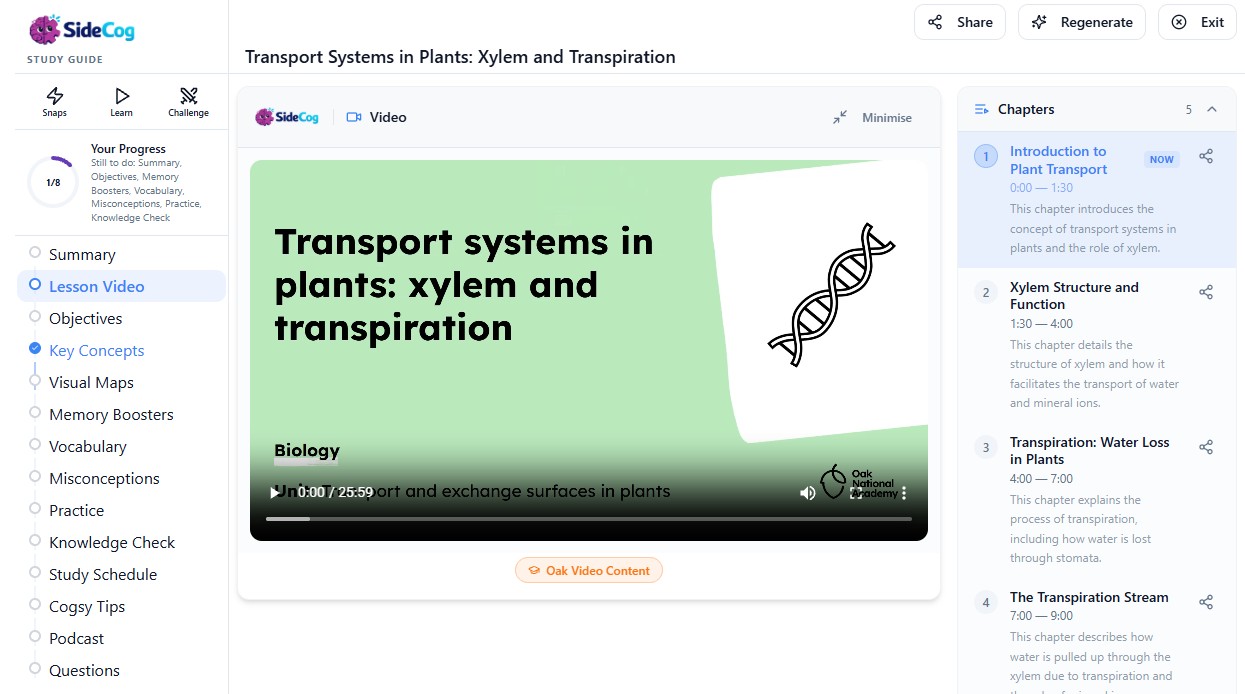
My experience with Oak Academy is also one of the reasons we have chosen to build upon Oak's curriculum architecture within the SideCog platform.
At SideCog, we do not believe the biggest challenge in education is access to content.
Students already have access to textbooks, videos, revision guides, websites and now AI-generated explanations.
The challenge is helping learners make sense of what they encounter.
Many students can recognise information. Far fewer can explain it.
Fewer still can connect ideas together, identify misconceptions or apply their knowledge confidently in unfamiliar situations. Take the Geese question in this years AQA GCSE Biology Paper 1 for example.
That is the problem SideCog was created to solve.
Oak provides something that many educational resources lack: a carefully sequenced curriculum built around clear learning objectives, progression and strong pedagogical thinking.
Rather than creating an entirely separate curriculum, SideCog builds upon Oak's curriculum architecture as a trusted foundation for learning.
This allows us to focus on helping students:
Diagnose misconceptions before they become embedded
Identify gaps in understanding
Connect knowledge across topics and subjects
Understand the Big Ideas that sit beneath the curriculum
Receive personalised explanations and support
Build confidence through understanding rather than memorisation
Our vision is simple.
- The curriculum provides the structure.
- Teachers provide the expertise.
- AI helps learners connect ideas, overcome misconceptions and develop deeper understanding.
By combining Oak's curriculum expertise with SideCog's diagnostic learning, connected knowledge mapping and adaptive AI, we aim to create learning experiences that help students understand not just what they need to know, but why it matters and how it connects to everything else they are learning.
For us, Oak is far more than a content source.
It is a high-quality curriculum foundation that enables us to focus on solving one of education's most persistent challenges: helping every learner move from knowing to understanding.
Not a silver bullet - but a powerful foundation
Oak Academy is not a magic solution.
No curriculum is.
Teaching will always require expertise, relationships, professional judgement and adaptation to the needs of individual learners.
However, as a curriculum foundation, Oak is exceptionally strong.
Particularly in schools facing:
High staff turnover
Non-specialist teaching
Limited curriculum development capacity
The need for rapid improvement
In my own department, Oak allowed us to stabilise, align and improve.
It gave us the breathing space to focus on the things that matter most: teaching, questioning, feedback and helping students think more deeply.
Final reflections
After more than fifteen years in education, I remain cautious about initiatives that promise quick fixes.
Oak Academy does not promise that.
What it offers is something far more valuable: a thoughtful, carefully sequenced curriculum that helps teachers teach and students understand.
Teach the content well.
Help students connect ideas.
Identify misconceptions.
Build understanding rather than memorisation.
Do that, and exam success becomes the outcome rather than the objective.
That is why I am a genuine advocate for Oak National Academy.
As a Head of Science, I have seen the impact that strong curriculum architecture can have on teaching and learning.
As a co-founder of SideCog, and someone who has spent many years exploring learning strategies, curriculum design and cognitive science, I believe that curriculum-led innovation offers one of the most exciting opportunities in education today.
Oak provides the curriculum architecture.
SideCog builds the intelligence layer on top.
Together, they represent a future where students are supported not simply to remember more, but to understand more deeply.
Written by
Julian Dance
Related articles
- SideCog Shorts | I want to help my child with revision, but I don’t know how.
Help your child revise without needing to know every answer. Join Julian for four practical 15-minute sessions on getting started, asking useful questions, trying better techniques and noticing progress.
28 September 2026
- AI Can Answer a Question, But Can It Teach?
AI can answer questions, but can it teach? Discover why SideCog puts pedagogy, adaptive teaching and lasting learning at the heart of educational AI.
22 September 2026
- Can Attendance and Behaviour Really Be Linked in an Ofsted Report?
When a school has excellent behaviour but still receives a “Needs Attention” judgement because of attendance, it raises an important question: how much can schools really control? After 20 years in education, Julian Dance reflects on attendance, curriculum relevance and whether we need to look more closely at why some young people disengage from learning.
8 September 2026
- What Trying to Speak Italian Taught Me About Learning
A 658-day Duolingo streak doesn't necessarily make you confident enough to order dinner. A family holiday in Sardinia got Julian thinking about context, confidence, retrieval - and the difference between completing activities and actually learning.
27 August 2026