
What we lose when we rush through Key Stage 3
What are the proposed Key Stage 3 curriculum changes?
On 8 November 2026, the Department for Education set out plans to protect Key Stage 3 (KS3), Years 7 to 9, as a distinct phase in England. The proposals aim to reduce overcrowding, improve the order in which topics are taught and discourage schools from starting GCSE courses early for large groups of pupils. First teaching of the revised curriculum is planned for September 2028, with revised GCSEs due to be introduced in phases in 2029 and 2030.
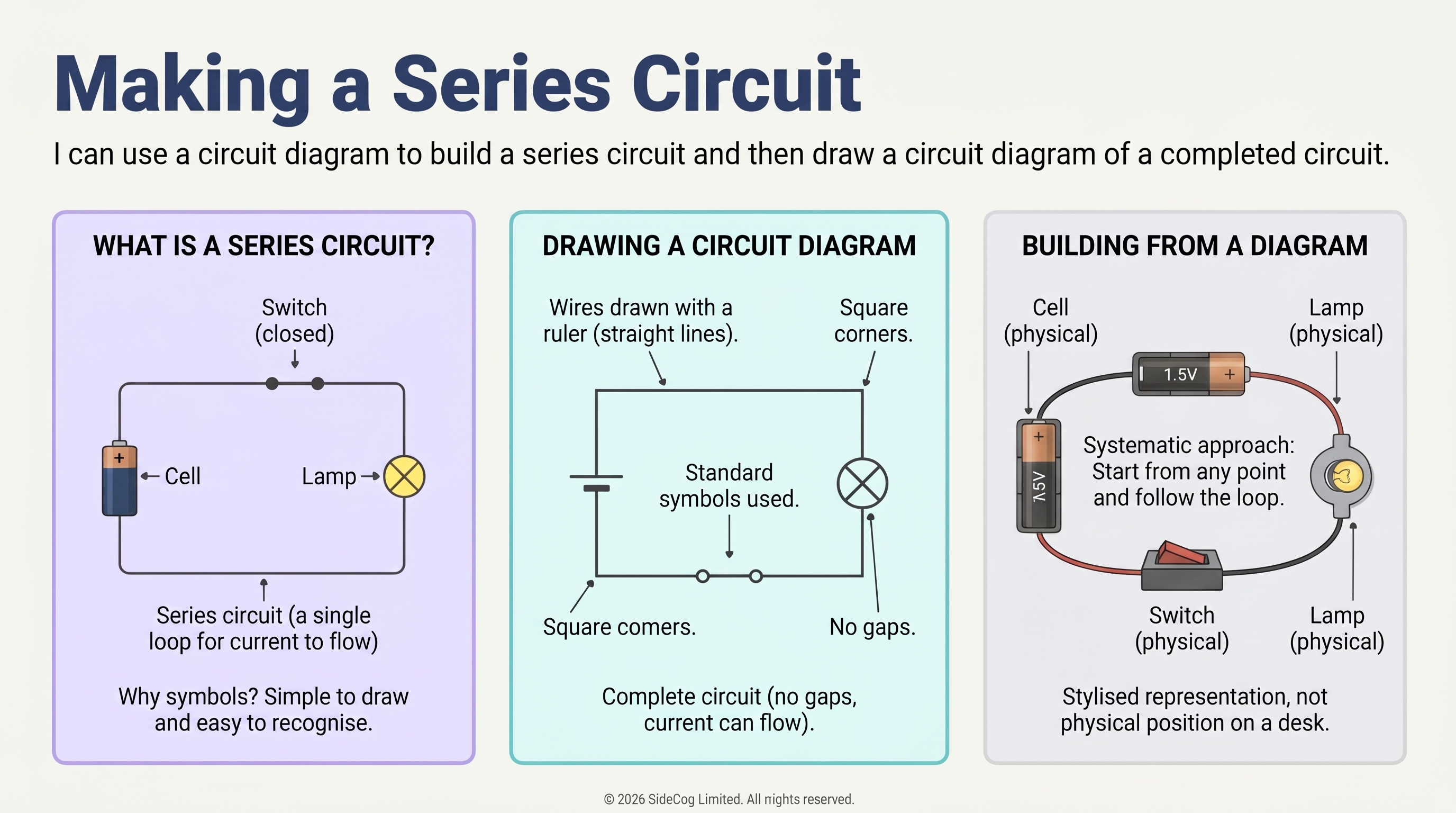
Ask a Year 8 pupil to define electric current and they might tell you it’s the rate of flow of charge. Then show them a simple circuit with a battery and a bulb. Is the current smaller on the other side of the bulb?
“It must be. The bulb’s used some of it to light up.”
I spent 20 years in the classroom, including as a head of science. That answer is where I’d want to slow down. The pupil has remembered a definition and used what they can see to make a prediction. Now there’s a chance to find out how they’re connecting those ideas, and to teach something that will matter the next time they meet a circuit.
Why protecting Years 7 to 9 matters
The plans would also discourage schools from routinely narrowing pupils’ subject choices or entering them for GCSEs early. Teachers would retain flexibility to stretch pupils who are ready to go further. The detailed programmes of study are still to come.
There’s a reason the timing matters. In October, research commissioned by the International Baccalaureate found that 57% of teachers surveyed identified GCSE preparation as a leading influence on what pupils study at KS3. Ofsted’s 2023 science report shows how this can play out. Many of the schools it visited began some GCSE content in Year 9 while still teaching the full breadth of KS3 science. In a few schools, pupils started GCSE content in Years 7 and 8 before they’d secured the knowledge it depended on, and missed out on parts of the KS3 curriculum.
That breadth matters in its own right. Time to play an instrument with other people, hold a conversation in another language or carry out an investigation in science can change how a pupil sees a subject and what they think they’re capable of. Years 7 to 9 give pupils time to discover those interests before they choose what to study next.
What struck me in Becky Francis’s curriculum review was the recommendation for science. It called for a clear sequence from primary through to GCSE, with the most important ideas taught in an order that lets pupils build on them and return to them in new contexts. Think of a pupil who has observed in Year 6 that changing the cells can change a bulb’s brightness. At KS3, they can start to explain what’s happening using ideas about current, potential difference and resistance. At GCSE, they can use those ideas to calculate how quickly a device transfers energy. Each step gives meaning to the next.
How a Year 8 circuits lesson builds understanding
Back to our circuit. I’d ask the pupil to predict what an ammeter would read on either side of the bulb. We’d measure it, then talk about why the readings match. The same amount of charge passes each point per second. The bulb transfers energy to its surroundings as light and heat.
Then I’d add a second bulb in series, keeping the same battery, and ask two questions. Will the two readings still match each other? Will they be the same as when there was just one bulb? Now the pupil has to connect two ideas. Current is the same at every point in a single loop, and adding resistance reduces the current throughout that loop.
I’d come back to the idea in a later lesson, too. A pupil might explain it perfectly with the circuit in front of them and fall back on their original thinking a fortnight later. The Education Endowment Foundation’s guidance on secondary science makes this point explicitly. Some misconceptions take time to shift, and teachers need to check whether that change lasts. That’s the kind of time a well-sequenced curriculum makes room for.
Why SideCog chose Oak National Academy
I first turned to Oak National Academy as a head of science, when my department needed a shared plan for what pupils should learn and in what order. What stayed with me was how deliberately Oak built one idea on another. Oak identifies the knowledge and vocabulary pupils need and maps how important concepts develop across units and years. That approach, and seeing it in use in my own department, helped shape our decision to build SideCog on Oak’s curriculum. Why I became an advocate for Oak National Academy
Take Oak’s Year 8 series circuits unit. It builds on earlier work exploring what happens when you change a circuit. Pupils then use current, voltage and resistance to explain what they observe in a single loop. In the next unit, they draw on that understanding to learn how electric circuits and magnetism interact. When a pupil gets stuck, that sequence gives you somewhere to look. Which earlier idea does this new one depend on?
How SideCog teaches from what a pupil already understands
That decision about what to teach next is at the heart of SideCog. In our guided sessions, Cogsy asks pupils to explain their thinking so it can work out where they’ve got stuck. One pupil may need to trace the path of the charge around the circuit. Another may know the path and need help distinguishing the flow of charge from the transfer of energy. Then they get a fresh question so they can try using the idea themselves. How SideCog diagnoses gaps in understanding
Teachers designed those sessions around the curriculum. AI helps adapt the next question, example or explanation to what the pupil says. If a pupil needs to stay with an idea, there’s time to do that. And if they’re worried about putting their hand up in class, they have a private space to say what they think and work it through.
If you teach KS3, what’s one idea you’d give another lesson to because so much of what comes next depends on it?
Written by
Julian Dance
Related articles
- When did GCSE revision become just a memory game?
How can you help your child revise after GCSE mocks? Use their answers to spot gaps, connect what they know and practise unfamiliar exam questions.
13 November 2026
- Can an AI Tutor Replace Private 1:1 GCSE Tuition?
Could an AI tutor help your child with GCSE revision, or will it simply give them answers? Julian Dance explains what good tutoring actually does, where AI can help, where a human tutor still matters, and four questions parents should ask before choosing a learning tool.
6 November 2026
- SideCog Shorts | I want to help my child with revision, but I don’t know how.
Help your child revise without needing to know every answer. Join Julian for four practical 15-minute sessions on getting started, asking useful questions, trying better techniques and noticing progress.
28 September 2026
- AI Can Answer a Question, But Can It Teach?
AI can answer questions, but can it teach? Discover why SideCog puts pedagogy, adaptive teaching and lasting learning at the heart of educational AI.
22 September 2026