
Why visuals matter in learning (and how they help children remember)
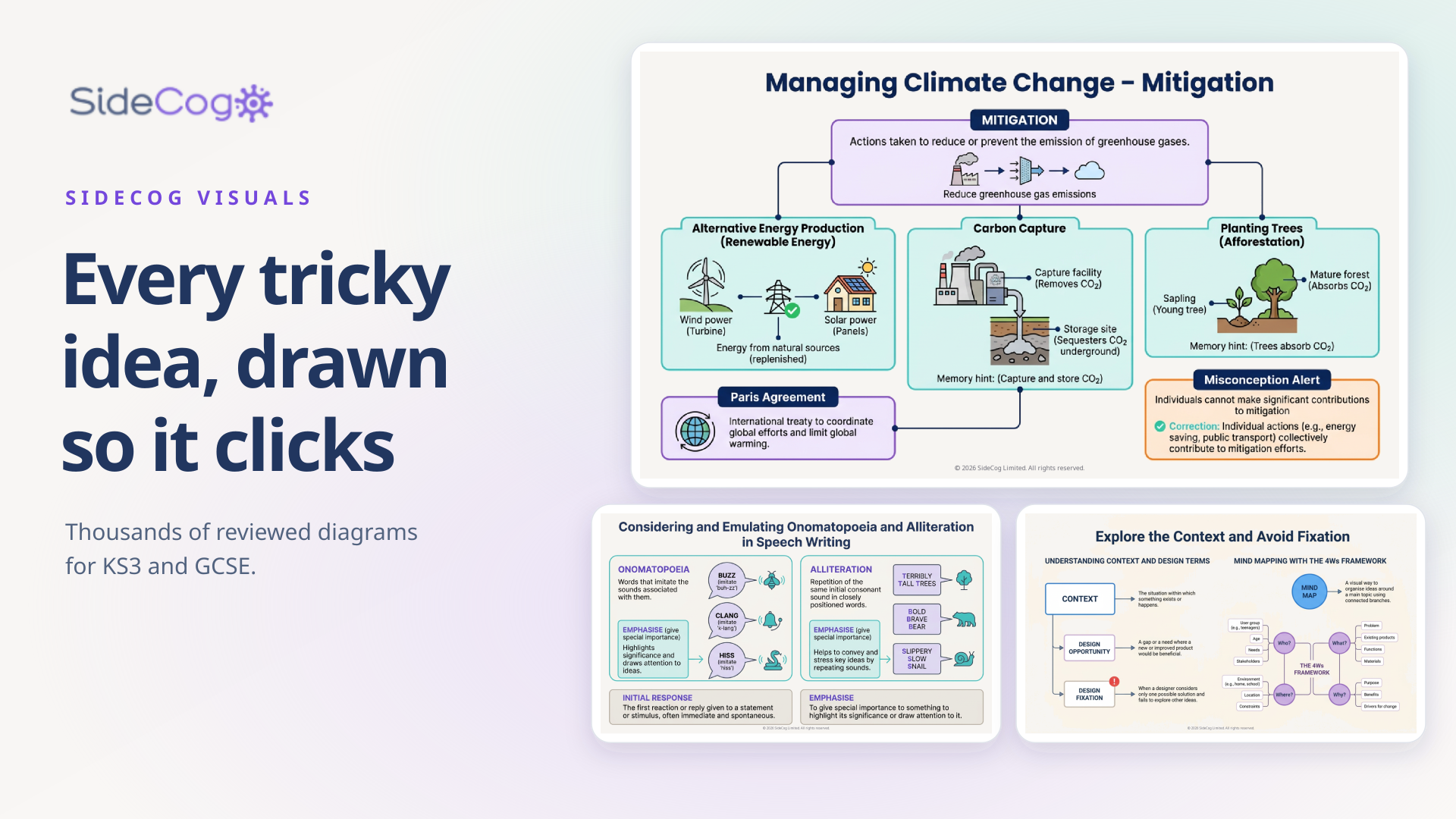
Have you ever tried explaining a tricky topic to your child, found yourself reaching for a pen and paper, and watched the penny drop as soon as you drew it?
A well-chosen visual can make an abstract idea easier to understand. It can show how different pieces of information fit together and give a child something concrete to explain, question and remember.
That's why we've developed SideCog Visuals, a collection of thousands of educational visuals for KS3 and GCSE learners.
When the maths suddenly makes sense
Imagine a GCSE maths question. A total of 100 tickets have been sold for £600. Adult tickets cost £8 and child tickets cost £4. How many of each were sold?
Some students are perfectly capable of solving simultaneous equations when the equations are given to them. Getting from that paragraph to two equations is where they get stuck.
This visual from SideCog shows how each piece of information fits into the maths.
Forming simultaneous equations, from the SideCog Visuals library.
The learner can follow the lines from the number of tickets sold to the first equation, A + C = 100, and from the ticket prices and total revenue to the second equation, 8A + 4C = 600.
Now ask them what would happen if a child ticket cost £3 instead. Which equation would change, and why?
A question like this helps us see whether they understand how the quantities and prices relate to the equations they have formed.
The science behind it – dual coding
Dual coding theory, first proposed by psychologist Allan Paivio, describes how verbal information and visual imagery can be represented and linked in memory. In learning, combining words with meaningful visuals can help build those connections and give children more cues to retrieve the knowledge later.
Richard Mayer's research on multimedia learning shows how pairing relevant illustrations with words can improve learning and the ability to apply knowledge. The Learning Scientists also explain how students can use this approach in their own revision.
Take this example from English.
Onomatopoeia and alliteration in speech writing, from the SideCog Visuals library.
Seeing the word 'buzz' next to a bee gives the learner a cue for the sound that word imitates. Highlighting the repeated initial consonants in 'slippery slow snail' helps them see the pattern that creates alliteration. Now ask them to say the phrases aloud, come up with their own examples and explain how they might use them in a speech.
A diagram can show how a process works. A timeline can help a learner place historical events in sequence. A map can connect geographical features with their location. The choice of visual should be driven by the idea being taught.
Julian shared a lovely example of this from a chemistry tutoring session where a student turned argon and lithium into characters in a hand-drawn comic. Through the story, the student explored how their electron arrangements relate to their reactivity. Read Using Drawing and Storytelling to Teach Chemistry: Dual Coding in Action.
Visuals can help reduce cognitive load
Working memory has a limited capacity. Think about that ticket question again. A student needs to keep track of two different prices, the number of tickets sold, the total revenue and what each letter represents.
The visual gives the learner a way to organise those relationships in one place. That can free up attention for the thinking involved in solving the problem.
Good design matters here. Unnecessary labels, decoration and unrelated pictures compete for attention. Richard Mayer describes this in his research on the coherence principle.
Make the visual work harder
A useful way to make a visual work harder is to recreate it yourself.
Research by Wammes, Meade and Fernandes (2016) found that participants remembered more words they had represented through drawings than words they had written down. This is known as the drawing effect. Translating an idea into a sketch involves deciding what matters, organising the information and thinking about how its parts connect.
Try this as a quick revision activity with your child.
- Choose a visual for a topic they are learning and talk through what it shows.
- Cover the visual and ask them to draw their own version from memory, using simple shapes, labels and arrows.
Compare their sketch with the original, correcting any gaps or misunderstandings.
Ask them to explain the concept in their own words and apply it to a different question.
This brings together dual coding, retrieval practice, explanation and feedback. There is a good opportunity to discover exactly which parts of a topic your child understands and which need a little more work.
We've explored this further in The Drawing Effect in Learning: How Sketching and Feedback Improves Memory and Understanding and our guide to effective GCSE revision.
The right visual at the right point in learning
SideCog can first surface a topic visual that brings together the key ideas a learner needs to understand. As a learning session progresses, Cogsy can select more targeted visuals organised around four teaching pillars. Take our simultaneous equations example above.
- Describe helps the learner identify key features, such as what the variables represent and the quantities involved.
- Explain makes the relationships visible. The diagram above shows how the ticket quantities and prices lead to two equations.
- Diagnose helps uncover misconceptions. Asking a learner to explain why A + C = 100 might reveal that they have confused the number of tickets with their monetary value.
- Assess checks understanding by asking the learner to apply what they have learnt. A visual based on a new situation could prompt them to form the equations themselves.
SideCog's visual selection also takes account of specific misconceptions, individual micro-ideas (the smaller building blocks of understanding within a topic), and the visual support needed by learners with special educational needs and disabilities (SEND).
This means Cogsy can draw on a visual that supports the particular idea a learner is working through and use it to guide the next step in their learning.
Why teacher expertise matters when generating visuals
Generative AI can produce impressive looking images in seconds. In education, however, a wrongly labelled part of a diagram or an arrow pointing in the wrong direction can leave a learner with a misconception that is surprisingly difficult to undo.
We wanted to avoid the problem of 'AI slop' in educational resources. SideCog has developed its own proprietary library of visuals, with teacher expertise guiding their generation and our team reviewing them before they are made available. The starting point is what the learner needs to understand, and how best to show it.
Even with careful review, the occasional error may slip through. We genuinely value your help in making our visuals better. If you spot something wrong, give the visual a thumbs-down in the app and tell us what you think needs correcting. You could win a prize for spotting an error!
Find a visual that helps it click
SideCog's visual library includes topics across maths, science, art, geography, English, history, music, computing and design and technology at KS3 and GCSE.
Simply tell Cogsy what you are working on, by speaking or typing. He can find relevant reviewed visuals for your year group, subject and learning needs. Swipe through them, ask questions about what you see, or open the full lesson.
The next time your child says, “I just don't get it”, try finding a visual together. Then ask them to show you what it means.
Explore SideCog Visuals
References
The Learning Scientists' guide to dual coding
Written by
Rachel Dance
Related articles
- Learning is hard. That doesn’t mean you’re bad at it.
A difficult question can make your child think they are bad at a subject. Discover why learning takes effort, how to respond when they get stuck and how to help them see their progress.
19 November 2026
- What we lose when we rush through Key Stage 3
Former head of science Julian Dance explains why the DfE’s plans for Key Stage 3 matter, what strong foundations look like in a Year 8 science lesson and why SideCog chose Oak National Academy’s curriculum.
16 November 2026
- When did GCSE revision become just a memory game?
How can you help your child revise after GCSE mocks? Use their answers to spot gaps, connect what they know and practise unfamiliar exam questions.
13 November 2026
- Can an AI Tutor Replace Private 1:1 GCSE Tuition?
Could an AI tutor help your child with GCSE revision, or will it simply give them answers? Julian Dance explains what good tutoring actually does, where AI can help, where a human tutor still matters, and four questions parents should ask before choosing a learning tool.
6 November 2026